
The short answer
Talent acquisition technology is the set of software tools recruiters use to attract, screen, interview, select and onboard candidates — from job boards and applicant tracking systems to AI voice screening, video interviews and hiring analytics. AI and automation now handle repetitive steps so recruiters can focus on judgement and relationships.
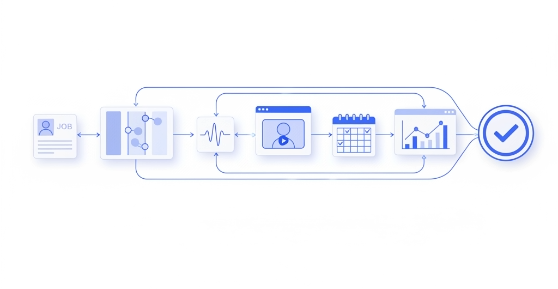
A hiring workflow rarely lives in one application. A candidate might discover a role on a job board, apply through a career site, enter an applicant tracking system, receive an interview invitation and eventually complete onboarding elsewhere. Talent acquisition technology connects the tools and information that make those steps possible.
Recruitment usually describes the work of filling an open position. Talent acquisition takes a longer view: building candidate relationships, anticipating skills needs, improving the hiring process and learning from outcomes. The distinction matters when choosing tools. A faster application form may help today's vacancy; a better candidate record can also help a future search.
The right HR tech stack depends on hiring volume, roles, candidate access and the team's existing process. It does not require replacing every system at once. Start by identifying where candidates wait, where recruiters repeat work and where information gets lost.
Key terms in the TA stack
- ATS
- Applicant tracking system: the record of applications, hiring stages and decisions.
- CRM
- Candidate relationship management: tools for maintaining contact with prospective and past candidates.
- AI screening
- Software that gathers or organises job-related candidate responses for human review.
- Structured interview
- An interview using defined, role-relevant questions and evaluation criteria.
- Recruitment automation
- Rules and workflows that move repeatable hiring tasks forward.
- Hiring analytics
- Measures that help teams understand process activity, delays and outcomes.
The Modern Talent Acquisition Technology Stack
Think of the stack as a connected workflow, not a shopping list. Each layer should give the next person or system enough context to act. The table shows where automation can help and where recruiter responsibility remains essential.
| Stage | Technology | What AI/automation adds | Recruiter role |
|---|---|---|---|
| Sourcing and attraction | Job boards, career sites, programmatic ads | Distributes approved openings and organises incoming interest. | Define the role, check messaging and build relevant candidate relationships. |
| Applicant tracking | ATS | Routes applications, updates stages and reduces duplicate administration. | Review records, correct errors and maintain a clear decision trail. |
| Candidate engagement | CRM, WhatsApp, SMS and email | Sends timely, consent-aware updates and tracks replies. | Set communication standards and respond personally when context calls for it. |
| First-round screening | AI voice screening, AI phone screening | Conducts configured initial conversations and organises answers. | Approve questions, review responses and handle exceptions. |
| Assessments and interviews | Skills tests, AI video interviews, proctoring | Coordinates structured steps and presents evidence for review. | Choose relevant assessments and interpret results with hiring managers. |
| Scheduling | Calendars and self-scheduling tools | Offers available slots and sends confirmations or reminders. | Make room for accessibility requests and unusual schedules. |
| Offer and onboarding | Offer workflows, document and onboarding tools | Tracks approvals, documents and task completion. | Discuss the offer, resolve concerns and support the handoff. |
| Analytics | Hiring dashboards and reports | Highlights stage delays, missing data and process patterns. | Investigate the reasons behind trends before changing policy. |
A table cannot capture every handoff. Before adding a tool, map which system owns each candidate record, what data crosses between systems and who resolves conflicting information.
Hear the screening layer in action
Explore how a configured voice conversation can collect candidate answers for recruiter review.
How AI and Automation Are Transforming Recruitment
AI in talent acquisition is most useful when it changes a specific task without obscuring accountability. These shifts affect different parts of the journey; none removes the need for a recruiter to understand a candidate's circumstances.
From manual dialling to AI voice screening
Initial calls can consume time before a recruiter reaches an answer that needs judgement. Configured voice conversations can ask approved questions, clarify incomplete replies and return a reviewable record. Recruiters still decide whom to progress and when a personal call is more appropriate.
AI calling for recruitmentAI phone screening guideFrom forms to conversations
A form captures fixed fields efficiently but cannot always clarify an ambiguous answer. Conversational screening lets a candidate explain availability, experience or a location preference in their own words. The goal is a clearer first-round record, not an unbounded interview.
Conversational AI in recruitmentFrom English-only processes to multilingual access
Phone-first candidates may be more comfortable explaining their experience in Hindi, Hinglish or another regional language. Mishuk Labs supports voice screening in 14+ Indian regional languages, including Hinglish. [Svarah] [Sharma et al. 2020] [IndicVoices] Teams should test the accents, code-mixing and call conditions they actually encounter. [Svarah] [Sharma et al. 2020] [IndicVoices]
Multilingual AI voice recruitingFrom unstructured impressions to comparable evidence
Research on structured interviews finds that defined, job-related questions and rating criteria improve reliability and validity compared with unstructured interviews. [Levashina et al. 2014] They do not make every answer directly comparable or eliminate bias. Recruiters should inspect underlying responses, note uncertainty and allow candidates to correct misunderstandings. [Raghavan et al. 2020]
From scheduling back-and-forth to self-scheduling
Calendar availability and automated confirmations can remove repeated coordination messages. Candidates still need a way to request another time or accommodation, and hiring teams need to keep interviewers' calendars accurate.
From gut feel to hiring analytics
Stage-level data can show where applicants wait, which callbacks remain unresolved and whether a process change creates new friction. It is evidence for investigation, not proof that one candidate or recruiter is better than another.
From disconnected tools to integrated workflows
APIs can pass approved fields between screening tools and an ATS so recruiters do not re-enter the same answers. Integration design should identify permissions, field ownership and error handling before launch; a connected workflow is only as reliable as its data.
AI interviewer and ATS integrationDeployment example: Store Manager hiring at V2 Mart Retail
Figures from one deployment. The time saving is a Mishuk Labs estimate — not a benchmark, time study or independent audit.
V2 Mart Retail used Mishuk Labs AI voice calling for high-volume Store Manager hiring across multiple locations in India, with screening in Hindi and English, automated shortlisting and WhatsApp/SMS follow-ups. Recruiters ran final interviews and made hiring decisions.
| Metric | Value | Basis |
|---|---|---|
| Use case and role | Retail · Store Manager, multi-location India | Deployment description |
| Languages | Hindi and English | Deployment description |
| AI screening calls | 900 | Call count from the deployment |
| Unique candidates, connected, completed | Not published | Not part of the published case study; we do not estimate them |
| Candidates shortlisted | Not published | Not part of the published case study; we do not estimate it |
| Campaign duration | Not published | Not reported |
| What recruiters received per screen | Call recording, original-language transcript, full English translation, structured summary and score, ATS or spreadsheet export | Product output for each completed screen |
| Recruiter time saved | ~150 hours (illustrative estimate calculated by Mishuk Labs) | Calculated by Mishuk Labs: 900 calls × an assumed 10 minutes of recruiter effort per manual call. Not time-tracked or independently verified. |
Illustrative estimate calculated by Mishuk Labs: approximately 150 hours, assuming 10 minutes of recruiter effort per manual call (900 calls × 10 minutes ÷ 60). The 10-minute figure is Mishuk Labs' assumption for dialling, conversation, breaks and notes; it was not supplied by V2 Mart, time-tracked or independently verified.
Limitations
- One customer, one role and two languages; results will differ by role, region and candidate list.
- The time saving is a Mishuk Labs calculation based on an assumption, not a figure reported or measured by V2 Mart; nothing here is independently audited.
- Without connection and completion counts, the example cannot show reach or drop-off.
- No candidate-feedback or quality-of-hire data was collected, so the article makes no claim about either.
Benefits for Talent Acquisition Teams
Each benefit below names the friction it addresses, how to measure it against your own baseline and where it tends to fail.
Earlier first contact
Friction: Applications wait days for a first call while recruiters are busy interviewing.
Measure: Median hours from application to first contact attempt, and share of applicants never contacted.
Fails when: Calls go out at times candidates cannot answer, or without the consent and number-series setup TRAI rules expect. [TRAI TCCCPR amendment 2025]
More room for recruiter judgement
Friction: Recruiters spend hours on repeat introductory calls.
Measure: Recruiter hours on first-round calls before vs after. For V2 Mart, Mishuk Labs estimates about 150 hours across 900 calls, assuming 10 minutes per manual call (not time-tracked). [V2 Mart case study]
Fails when: Recruiters still re-call every candidate because they do not trust the transcripts.
A more consistent starting point
Friction: Different recruiters ask different first questions. [Levashina et al. 2014]
Measure: Share of screens with every required question answered.
Fails when: Identical questions disadvantage some candidates, for example through speech-recognition error gaps. [Koenecke et al. 2020]
A candidate experience that fits the audience
Friction: English-only forms and fixed calling hours exclude phone-first candidates.
Measure: Completion rate by language and time slot, with denominators stated (for example, the healthcare deployment reported about 52% of all unique candidates versus 59% of connected candidates).
Fails when: No human route exists or the candidate's language is poorly recognised. [Svarah] [Sharma et al. 2020]
Capacity during hiring spikes
Friction: Festive retail, campus and branch-launch bursts.
Measure: Backlog of unscreened applicants per day.
Fails when: Unanswered calls are treated as rejections.
Better process data
Friction: Decisions live in recruiters' notes.
Measure: Share of decisions with a linked recording or transcript.
Fails when: Records are retained longer than the purpose needs. [DPDP Act 2023]
Use Cases by Industry
The same stack should not impose identical questions on every role. Start with the evidence a hiring manager actually needs for the next decision, then choose the channels candidates can access.
IT
Coordinate skills evidence, availability and technical interview handoffs without treating a first-round screen as a technical verdict.
Enterprise interviews and ATS integrationBFSI
Organise location preferences, frontline experience and follow-ups while keeping regulated-role assessments with the hiring team.
BFSI voice recruitmentRetail
Prepare for store openings by clarifying location, shift availability and customer-facing experience early.
Retail hiring workflowsManufacturing and logistics
Ask about site, shift and stated certification details, then flag anything requiring verification by a person.
Manufacturing workforce guideLogistics hiring in IndiaBPO and call centers
Confirm language comfort and schedule preferences without using one short recording as a complete communication assessment.
AI audio interviewsCampus hiring
Keep large interview queues and evaluation criteria organised while offering students clear instructions and support.
Campus video interviewsStaffing agencies and RPO
Maintain distinct client requirements and candidate histories so a fast first contact does not become a generic screen.
Recruitment agency calling guideHow to Choose Talent Acquisition Technology
Begin with a workflow map and an accountable owner for each stage. A pilot on one role is more informative than a feature comparison detached from actual candidate and recruiter needs.
- Identify the bottleneck first: delayed contact, repeated data entry, scheduling or unclear evaluation?
- Check fit with the existing ATS, including APIs, permissions, field mappings and failure handling.
- Match languages and channels to candidates; phone-first applicants in India may need a different path from desk-based applicants.
- Ask how AI evaluations are explained and whether reviewers can inspect underlying answers.
- Keep human-in-the-loop controls for corrections, exceptions and final decisions.
- Map consent, notice, security, breach and erasure obligations under the DPDP Act, 2023 and the phased DPDP Rules, 2025. [DPDP Act 2023] [DPDP Rules 2025]
- Confirm Principal Entity registration, number series and consent handling under TRAI's TCCCPR before automated calling. [TRAI TCCCPR amendment 2025]
- Monitor outcomes by language, region and other candidate groups, and ask vendors how they validate and test for bias. [Raghavan et al. 2020] [Koenecke et al. 2020]
- Plan recruiter training, candidate support and a clear escalation route.
- Pilot one role and compare contact, review effort and candidate feedback against your own baseline.
Challenges and Limitations
Tool sprawl creates extra logins, conflicting candidate records and uncertain ownership. Poor data quality compounds the problem: automation can move an outdated phone number or incorrect stage faster without making it correct. Set field owners and review integration errors.
Over-automation can make a candidate feel unable to ask a question or reach a person. State when an interaction uses AI, provide a route to a recruiter and avoid treating a missed call as a judgement on interest or suitability.
Speech recognition is not equally accurate for everyone. A benchmark of Indian-accented English found clear room for improvement across commercial and open models; a US study found commercial systems made nearly twice as many errors for Black speakers as for white speakers; word error rates rise as background noise increases; and Hindi–English models struggle at code-switch points. Flag low-confidence transcripts, let candidates clarify and spot-check recordings by language. [Svarah] [Koenecke et al. 2020] [Radford et al. 2022] [Sharma et al. 2020]
Consistency is not fairness. A review of 18 algorithmic hiring vendors found limited public disclosure on how tools were validated or tested for bias. Ask for validation evidence, compare pass-through rates across candidate groups and keep a human decision point. [Raghavan et al. 2020]
Change management is part of implementation. Recruiters and hiring managers need to understand what a tool captures, what it cannot infer and how to correct a record before expanding its use.
Talent acquisition skillsAI tools for HR teamsIndian Legal Obligations vs Voluntary Frameworks
Two Indian instruments matter most for automated recruitment workflows. This summary is general information, not legal advice, and citing a law here does not establish that any workflow complies with it.
DPDP Act, 2023 and DPDP Rules, 2025 [DPDP Act 2023] [G.S.R. 843(E)] [DPDP Rules 2025]
- Applies to digital personal data processed in India, which covers candidate names, phone numbers, call recordings and transcripts (Section 3).
- The employer that decides why and how candidate data is processed is the Data Fiduciary; a screening vendor processing on its behalf acts as a Data Processor under contract (Section 8(2)).
- From 13 May 2027, processing is permitted with consent given after a notice describing the data and purpose, or for one of the 'certain legitimate uses' listed in Section 7 (Sections 5–7). Whether the employment use in Section 7(i) extends to prospective applicants is a legal interpretation for an Indian privacy lawyer; do not assume it does.
- Data Fiduciaries must keep reasonable security safeguards, notify the Data Protection Board and affected people of breaches, and erase data once the purpose is served unless law requires retention (Section 8).
- The section-level duties in points 1–4 describe the Act as enacted; most commence on 13 May 2027.
- Commencement (G.S.R. 843(E), 13 Nov 2025): definitions and the Data Protection Board provisions are in force since 13 Nov 2025; consent-manager provisions (s. 6(9), Rule 4) from 13 Nov 2026; notice, consent, legitimate uses and Data Fiduciary duties (ss. 3–17) and DPDP Rules 3 and 5–16 commence on 13 May 2027. Until then, IT Act s. 43A continues to apply. Designing for notice and consent now avoids rework later.
TRAI TCCCPR, 2018 (as amended in 2025 and 2026) [TRAI TCCCPR amendment 2025] [TRAI 1601 direction] [PIB on 1600] [PIB on 1601 Phase I]
- Applies to commercial communications over Indian telecom networks, including automated voice calls.
- Senders register as Principal Entities with an access provider and call from registered telecom resources.
- Promotional voice calls use the 140 series. The 1600 series is for service and transactional calls by RBI-, SEBI-, IRDAI- and PFRDA-regulated entities and Central/State Government entities. The 1601 series is being implemented in phases; Phase I (Aug 2026) covers only utilities and courier/logistics entities.
- Consent, where required, is recorded through the consent framework, and calls must respect customers' recorded preferences (DND categories and time bands).
- TRAI's numbering framework distinguishes promotional and service/transactional calls. The cited guidance does not establish a dedicated numbering category for recruitment screening calls. Recruitment teams should confirm the applicable classification, registration and numbering requirements with their telecom provider before deploying automated calls, and have an Indian telecom-compliance lawyer review this before relying on it.
International frameworks on AI risk can help structure internal reviews, but they are voluntary and do not replace Indian legal obligations. Mishuk Labs' DPDP alignment is a self-assessment, not a certification.
Where Mishuk Labs Fits
Mishuk Labs sits in the screening and interview layer of a talent acquisition technology stack. Its AI voice screening uses role-specific questions and contextual follow-ups in 14+ Indian regional languages, including Hinglish. Candidate evaluations are organised for recruiter review; AI video interviews can support later interview steps.
ATS integration is available through APIs, with fields configured during onboarding according to the connected system's API permissions. Mishuk Labs does not replace sourcing tools, job posting systems or an ATS. Recruiters review the evidence, speak with candidates when needed and make final hiring decisions.
Customer Evidence: What Is and Isn't Published
Each story below links to a published case study. Figures are not independently audited; where a figure is a Mishuk Labs estimate, it is labelled as such. Customers are named only where they have approved it.
V2 Mart Retail
Store Manager hiring, Hindi and English AI voice calling
Published evidence: ~150 recruiter hours saved — illustrative Mishuk Labs estimate (900 calls × assumed 10 min); not time-tracked
Read case studyProtean eGov Technologies
Role-specific technical first-round phone screening for Data Engineer, SOC 2 Analyst and Data Privacy Manager roles
Published evidence: Use-case description; no performance metric is claimed in this article
Read case studyLeading Indian healthcare company (name withheld)
Multilingual voice screening in Kannada, Malayalam, Telugu and Tamil across South India
Published evidence: 5,000 unique candidates contacted; ~52% of them completed a screen (59% of those connected)
Read case studyAnonymous Bengaluru-based Indian NBFC
Field Sales Officer hiring across seven states using AI Phone Calling in seven recruiter-assigned languages
Published evidence: 5,800 of 6,200 answered candidates completed screening (93.5%); 400 shortlisted by the NBFC's recruiters from 400 AI suggestions
Read case studyLeading Indian bank (name withheld)
Structured, proctored AI video interviews in Hindi and English for Frontline Sales Managers
Published evidence: Use-case description; see the case study for scope
Read case studyThe Future of Talent Acquisition Technology
Regulation will shape the stack. Under the DPDP Rules, 2025, detailed notice, security, breach and retention rules apply from 13 May 2027, so recruitment tools need data maps, retention settings and breach processes before then. TRAI has amended its commercial-communication rules several times since 2025, so calling setups need periodic review. [DPDP Rules 2025] [TRAI TCCCPR amendment 2025]
Multilingual voice will improve as Indian speech datasets grow, but gains will be uneven across languages and accents, so teams should keep testing on their own candidates rather than relying on vendor averages. Agentic workflows that coordinate steps across tools will need explicit permissions, logs and escalation to a person. [IndicVoices] [Svarah]
Conclusion
Talent acquisition technology works best as a deliberate set of connected tools, each solving a visible problem in the candidate journey. AI can organise repeatable contact, screening and coordination; recruiters supply context, relationships and judgement. Map the workflow, pilot one role, review the evidence and expand only where the process improves for both candidates and hiring teams.
Frequently Asked Questions
Sources
Indian law and regulation
- Digital Personal Data Protection Act, 2023 — official text (MeitY PDF)
Sets out notice (s. 5), consent (s. 6), certain legitimate uses including employment (s. 7(i)), Data Fiduciary duties (s. 8), and omission of IT Act s. 43A (s. 44(2)).
- Ministry of Electronics and Information Technology, notification G.S.R. 843(E), 13 Nov 2025, appointing commencement dates under the Digital Personal Data Protection Act, 2023
Appoints 13 Nov 2025 for ss. 1(2), 2, 18–26, 35, 38–43 and 44(1), (3); 13 Nov 2026 for ss. 6(9) and 27(1)(d); and 13 May 2027 for ss. 3–5, 6(1)–(8), (10), 7–17, 27 except 27(1)(d), 28–34, 36–37 and 44(2).
- Digital Personal Data Protection Rules, 2025 — Gazette notification G.S.R. 846(E), 13 Nov 2025 (PDF)
Rules 1–2 and 17–21 in force from 13 Nov 2025; Rule 4 from 13 Nov 2026; Rules 3 and 5–16 (notice, security, breach, retention) from 13 May 2027.
- Telecom Regulatory Authority of India, "Telecom Commercial Communications Customer Preference (Second Amendment) Regulations, 2025," 12 Feb 2025 (PDF)
Sender registration and customer preferences; promotional voice calls through the 140 series only; the 1600 series (or another series allotted for the purpose) for service and transactional voice calls.
- Telecom Regulatory Authority of India, direction on allocation and operationalisation of the 1601 numbering series for service and transactional voice calls (Aug 2026)
Direction of 10 Aug 2026 allotting the 1601 series for service and transactional voice calls, implemented in phases; Phase I covers utilities and courier/logistics entities only, with other sectors to be notified later.
- Press Information Bureau, clarification on the 1600 numbering series for BFSI and government service and transactional calls
The 1600 series is for service and transactional calls by entities regulated by RBI, SEBI, IRDAI and PFRDA, and by Central and State Government entities.
- Press Information Bureau, "TRAI issues direction for 1601 numbering series for service and transactional voice calls — Phase I: utilities, courier and logistics" (Aug 2026)
Phase I of the 1601 series covers utilities and courier/logistics entities; 90-day migration; further sectors to be notified after review.
Research
- Levashina, Hartwell, Morgeson & Campion, The Structured Employment Interview: Narrative and Quantitative Review of the Research Literature (Personnel Psychology, 2014)
Narrative and meta-analytic review of structured interview research; more structure is associated with higher reliability and validity than unstructured interviews.
- Svarah: English ASR on Indian accents (Interspeech 2023)
9.6 hours of Indian-accented English from 117 speakers in 65 locations; tested Whisper, wav2vec 2.0, HuBERT, WavLM, Data2Vec, Conformer, Azure and Google ASR and found clear room for improvement.
- Koenecke et al., racial disparities in ASR (PNAS 2020)
US English interviews (CORAAL, VOC) across five commercial ASR systems; average WER 0.35 for Black vs 0.19 for white speakers. US English, not Indian speech.
- Radford et al., Robust Speech Recognition via Large-Scale Weak Supervision (Whisper, 2022)
Tested English ASR under added white and pub noise; word error rates rose as the signal-to-noise ratio fell.
- Sharma et al., code-switched Hindi–English ASR (Interspeech 2020)
Low-resource Hindi–English ASR using 12 hours of real code-switched speech; found models struggled at switch points and TTS augmentation reduced WER by up to 5% absolute.
- Raghavan et al., Mitigating bias in algorithmic hiring (FAT* 2020)
Reviewed public claims and practices of 18 vendors of algorithmic pre-employment assessments; found limited disclosure on validation and bias testing.
- IndicVoices (Findings of ACL 2024)
7,348 hours of read, extempore and conversational speech from 16,237 speakers in 145 districts across 22 languages, collected because Indian-language ASR needs more diverse data.
Mishuk Labs customer stories
- Mishuk Labs customer story: V2 Mart Retail
Store Manager hiring deployment with 900 AI screening calls. The ~150 recruiter hours saved figure is an illustrative estimate calculated by Mishuk Labs (900 calls × an assumed 10 minutes of recruiter effort per manual call); not time-tracked or independently verified.