
The short answer
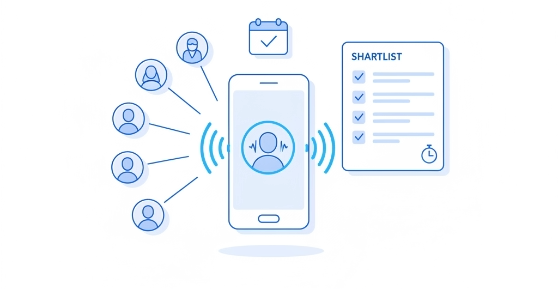
AI calling for recruitment uses AI voice agents to place automated phone calls to candidates — reaching out to applicants, asking initial screening questions, following up on missed calls and evaluating responses against job criteria — so recruiters spend less time on first-round dialling and more on interviews and hiring decisions. Whether shortlists actually arrive sooner depends on your volumes, connection rates and review process, and should be measured against your current time-to-shortlist.
A recruiter sets the role requirements and provides applicants to contact. A voice agent then calls within configured windows, asks relevant questions and records answers for review. AI automated calls for hiring are most useful for repeatable first-round conversations, not for sourcing applicants or making final hiring decisions.
Unlike a recorded robocall or an IVR menu, a conversational agent listens to an answer and can ask a relevant follow-up. For example, if someone says they can join next month, it can ask for a date instead of moving straight to the next unrelated question. [Jurafsky & Martin] [Product demo]
How AI Recruitment Calls Work
Start with applicants
A hiring team supplies an applicant list or configures new applications to trigger outreach at appropriate times.
Introduce the call
The agent identifies the organisation, can be configured to disclose that it is AI (agreed during onboarding), asks whether the candidate is willing to continue and asks about preferred language. A verbal "yes" on the call is not DPDP consent: under the DPDP Act, processing relies on consent given after notice, or on one of the 'certain legitimate uses' in Section 7, and whether the employment use covers applicants is a question for counsel. These DPDP provisions commence on 13 May 2027. [DPDP Act 2023] [G.S.R. 843(E)]
Ask role-specific questions
It collects details such as availability, location and relevant experience using questions approved for the opening.
Clarify the answer
A contextual follow-up checks an incomplete or ambiguous response rather than assuming what the candidate meant. [Product demo]
Handle missed calls
Retries run only inside configured calling windows that respect the candidate's recorded preferences, and a rescheduling request creates a next step. An unanswered call is not treated as a rejection. [TRAI TCCCPR amendment 2025]
Organise the evidence
Responses are evaluated against the team's criteria and summarised, with unclear or missing details visible to reviewers.
Return control to the recruiter
A recruiter checks the underlying answers, follows up where needed and decides whom to invite to the next stage.
Illustrative example — not a customer deployment
A staffing firm is hiring delivery associates in Pune. One applicant prefers Marathi and says he owns a two-wheeler, but his licence renewal is pending. The agent asks when renewal is expected and which delivery zone he prefers. The recruiter sees the pending licence flagged in the summary and can verify it before proceeding.
What the recruiter sees: one candidate, four criteria
| Criterion | Candidate said (translated from Marathi) | Captured | Evaluation |
|---|---|---|---|
| Owns a two-wheeler | Haan, maazhi swatachi bike aahe — yes, I have my own bike. | Own two-wheeler: yes | Meets criterion |
| Valid driving licence | Licence renewal pending, should come next week. → follow-up "When do you expect it?" → "By the 20th." | Licence: renewal pending, expected by 20th | Needs recruiter check — verify document before offer |
| Available for 8am–5pm shift | Morning is fine, but not Sundays. | Shift: yes; Sundays unavailable | Partially meets — role requires one weekend day; recruiter to discuss |
| Preferred delivery zone | Kothrud or Karve Nagar. | Zone: Kothrud / Karve Nagar | Informational — no score |
Summary for recruiter: 1 criterion met, 1 needs document verification, 1 partially met, 1 informational. Suggested status: Hold for recruiter review — not auto-rejected.
The agent does not decide. Scores and statuses are configured by the hiring team; the recruiter can listen to the recording, read the original-language transcript and override any evaluation.
Key Benefits of AI Calling for Recruiters
Treat these as hypotheses to measure in a pilot. Do not claim an improvement without before-and-after data from your own workflow.
Earlier first contact
Configured outreach can begin soon after an application arrives, while a recruiter is handling interviews or other priorities.
How to measure: Median time from application to first call attempt.
Less repetitive dialling
Introductions and routine availability questions no longer require a recruiter to place every initial call personally.
How to measure: Recruiter hours spent on first-round calls, before and after.
A consistent starting point
Applicants for the same role can receive the same core questions, with follow-ups for answers that need clarification. [Levashina et al. 2014]
How to measure: Percentage of completed screens that cover all required questions.
More language options
Supported spoken languages can help candidates respond comfortably; teams should still test local accents and mixed-language speech. [IndicVoices] [Svarah] [Sharma et al. 2020]
How to measure: Completion rate by language, with the denominator stated (connected vs all candidates).
Follow-ups with a defined path
Missed calls and requests to speak later can be tracked instead of disappearing into a busy calling queue.
How to measure: Callback completion rate.
Capacity during hiring spikes
Automated recruitment calls can help organise first contact during festive hiring, campus drives or store and branch launches.
How to measure: Backlog of unscreened applicants per day during the spike.
Notes ready for review
Structured answers make it easier to spot open questions before a recruiter spends time on the next conversation.
How to measure: Percentage of screens with a reviewable recording and transcript.
Manual Calling vs AI Calling for Recruitment
Neither approach fits every candidate. The comparison below is about where a recruiter's time is best spent, not removing people from the process.
| Consideration | AI calling | Manual recruiter calling |
|---|---|---|
| Speed of first contact | Can start within configured calling windows after an application; actual speed depends on connection rates. | Depends on a recruiter's schedule and calling queue. |
| Volume capacity | Can conduct separate configured first-round calls in parallel. | Each live conversation needs recruiter time. |
| Consistency of questions | Uses approved role questions with contextual clarification. | Can adapt freely, though coverage may vary between calls. |
| Follow-ups | Can track configured retries and rescheduling requests. | A recruiter can agree on a personal follow-up directly. |
| Language coverage | Depends on supported, tested languages and speech quality. | Depends on the team's language skills. |
| Documentation | Organises captured responses for review. | Relies on notes taken during or after the call. |
| Recruiter time | Shifts effort toward exceptions and next-round conversations. | Requires attention for every introduction and first screen. |
| Best for | Repeatable initial screens across an active applicant queue. | Senior, niche or passive candidates and offer conversations. |
Manual calls remain especially valuable when trust, negotiation or an unexpected personal circumstance calls for a skilled human conversation.
Hear a first-round voice screen
Explore how a configured call can collect candidate answers for recruiter review.
Deployment example: Store Manager hiring at V2 Mart Retail
Figures from one deployment. The time saving is a Mishuk Labs estimate — not a benchmark, time study or independent audit.
V2 Mart Retail used Mishuk Labs AI voice calling for high-volume Store Manager hiring across multiple locations in India, with screening in Hindi and English, automated shortlisting and WhatsApp/SMS follow-ups. Recruiters ran final interviews and made hiring decisions.
| Metric | Value | Basis |
|---|---|---|
| Use case and role | Retail · Store Manager, multi-location India | Deployment description |
| Languages | Hindi and English | Deployment description |
| AI screening calls | 900 | Call count from the deployment |
| Unique candidates, connected, completed | Not published | Not part of the published case study; we do not estimate them |
| Candidates shortlisted | Not published | Not part of the published case study; we do not estimate it |
| Campaign duration | Not published | Not reported |
| What recruiters received per screen | Call recording, original-language transcript, full English translation, structured summary and score, ATS or spreadsheet export | Product output for each completed screen |
| Recruiter time saved | ~150 hours (illustrative estimate calculated by Mishuk Labs) | Calculated by Mishuk Labs: 900 calls × an assumed 10 minutes of recruiter effort per manual call. Not time-tracked or independently verified. |
How the time saving was calculatedAssumption
Illustrative estimate calculated by Mishuk Labs: approximately 150 hours, assuming 10 minutes of recruiter effort per manual call (900 calls × 10 minutes ÷ 60). The 10-minute figure is Mishuk Labs' assumption for dialling, conversation, breaks and notes; it was not supplied by V2 Mart, time-tracked or independently verified.
Limitations
- One customer, one role and two languages; results will differ by role, region and candidate list.
- The time saving is a Mishuk Labs calculation based on an assumption, not a figure reported or measured by V2 Mart; nothing here is independently audited.
- Without connection and completion counts, the example cannot show reach or drop-off.
- No candidate-feedback or quality-of-hire data was collected, so the article makes no claim about either.
Practical Use Cases
Start with questions that help a recruiter plan the next step. A short call should not try to replace a specialist interview.
IT recruitment
Check notice period, current CTC expectations range, location and stated core skills before a technical round.
Read the hiring workflow guideBFSI hiring
Clarify location preference, relevant frontline experience and interview availability.
Explore BFSI hiringRetail
Ask about store location, customer-facing experience and shifts before scheduling a conversation.
Explore retail callingManufacturing
Collect shift and site preferences and ask about stated trade certifications for human verification.
Explore manufacturing workflowsBPO and call centers
Confirm language comfort and night-shift readiness without treating one short call as a complete communication assessment.
Read the audio interview guideHigh-volume hiring and staffing agencies
Keep each client's role criteria distinct while organising callbacks and first-round answers.
High-volume recruitment guideAgency calling guideFeatures Recruiters Should Evaluate
When assessing AI recruitment calling software, request a demonstration using a real opening and an unclear candidate answer. Check the working process as carefully as the voice.
- Natural two-way conversation: can a candidate interrupt, correct or clarify an answer?
- Indian languages and code-mixed speech: test the accents and Hindi–English code-mixing applicants actually use. [Svarah] [Sharma et al. 2020]
- Role-specific questions: can the hiring team approve what is asked for each opening?
- Contextual follow-ups: does the agent clarify uncertainty without inventing facts?
- Retries and calling windows: are missed calls and rescheduling handled respectfully?
- Transparent evaluation: can reviewers inspect summaries and underlying answers or recordings where available? [Raghavan et al. 2020]
- Human review and override: can recruiters correct an interpretation before taking action?
- Privacy and consent: assess notice, access and retention against the DPDP Act. [DPDP Act 2023] [G.S.R. 843(E)] [DPDP Rules 2025]
- Calling compliance: Confirm the classification of recruitment calls, sender registration and the appropriate numbering series with your telecom provider. Do not assume recruitment screening calls qualify for the 1600 or 1601 service and transactional series. [TRAI TCCCPR amendment 2025] [PIB on 1600] [PIB on 1601 Phase I]
- Reporting: can the team identify completions, callbacks and unresolved questions?
- Existing workflow: can results be handed to the people responsible for the next step?
Limitations and Best Practices
Network noise, unfamiliar accents and code-mixing can affect what an agent hears. Let candidates repeat or correct an answer, and flag uncertainty for a person rather than turning it into a negative assessment. [Radford et al. 2022] [Svarah] [Koenecke et al. 2020] [Sharma et al. 2020]
Some candidates prefer speaking to a human. Offer that path, keep questions job-related and leave final decisions with recruiters. Monitor outcomes by language, region and other candidate groups; a review of 18 vendors of algorithmic pre-employment assessments found limited public disclosure on validation and bias testing, so ask for evidence rather than assume it. [Raghavan et al. 2020] [Koenecke et al. 2020]
Today IT Act s. 43A applies; from 13 May 2027, DPDP processing requires consent after notice or a Section 7 legitimate use (whether Section 7(i) covers prospective applicants needs counsel), alongside applicable Data Fiduciary duties and detailed DPDP Rules. Automated calls over Indian telecom networks fall under TRAI's TCCCPR: promotional calls use the 140 series; the 1600 series is limited to specified BFSI and government entities, and 1601 Phase I covers only utilities and courier/logistics — so confirm with your telecom provider how recruitment calls are classified and which series applies, rather than assuming 1600 or 1601. This is general information, not legal advice. [DPDP Act 2023] [G.S.R. 843(E)] [DPDP Rules 2025] [TRAI TCCCPR amendment 2025] [TRAI 1601 direction] [PIB on 1600] [PIB on 1601 Phase I]
Pilot AI phone screening on one role first. Review real callbacks, misunderstandings and recruiter effort before expanding the workflow.
Conversational AI in recruitmentAI phone screening guideWhere Mishuk Labs Fits
Mishuk Labs offers voice-based candidate screening with role-specific questions and contextual follow-ups in 14+ Indian languages, including code-mixed Hindi–English speech. It evaluates responses and organises them for recruiter review.
AI video interviews can support later rounds. Recruiters remain responsible for checking the evidence, speaking with candidates when needed and making hiring decisions.
Multilingual voice recruitingAI video interviewsConclusion
AI calling for recruitment helps teams move repeatable first contact, screening and follow-ups through a defined process. The useful result is a clearer queue of answers and exceptions for recruiters to review. Begin with one role, keep candidates informed and give people the final say.
Frequently Asked Questions
What is AI calling for recruitment?
AI calling for recruitment uses a voice agent to contact applicants by phone, ask approved first-round questions and organise their answers for recruiter review. It can also handle configured callbacks or rescheduling. The hiring team supplies applicants and job criteria; people inspect the responses and decide what happens next.
How is AI calling different from robocalls or IVR?
A robocall plays a recorded message, while IVR typically asks callers to choose from a fixed menu. A conversational voice agent listens to spoken answers, keeps track of the current question and can ask a relevant follow-up. It should still flag an answer it cannot confidently understand. [Jurafsky & Martin]
Can AI calls replace recruiters?
No. A configured agent can take on repeatable introductions, initial questions and callbacks, but it may misunderstand speech or miss important context. Recruiters define the criteria, review underlying answers, handle sensitive or unusual situations and make hiring decisions. Human contact remains important when candidates request it.
What questions can an AI voice recruiter ask candidates?
An AI voice recruiter can ask job-related questions approved by the hiring team, such as availability, location preference, shift readiness, stated experience or notice period. It can clarify an incomplete answer within its configured workflow. Sensitive matters and questions requiring judgement should be handed to a recruiter.
Does AI calling work in Hindi and regional Indian languages?
Language support depends on the product and the workflow being used. Mishuk Labs supports voice-based screening in 14+ Indian languages, including code-mixed Hindi–English speech. Hiring teams should test the accents, code-mixing and call conditions their applicants actually encounter, and provide a way to correct misunderstood answers. [IndicVoices] [Sharma et al. 2020]
How do AI recruitment calls evaluate candidates?
A team defines job-related questions and criteria. The system captures responses, organises them against those criteria and can highlight missing or uncertain information for review. Its evaluation is an aid to prioritising work, not a final hiring decision; recruiters should verify the underlying answers before acting.
Is AI calling for recruitment legal and compliant in India?
Compliance depends on how a team handles candidate data and conducts outreach under applicable rules, including the Digital Personal Data Protection Act, 2023, the DPDP Rules, 2025 and TRAI commercial-communication requirements. DPDP notice and consent duties commence on 13 May 2027; review the proposed workflow with qualified legal counsel before launch. This is general information, not legal advice. [DPDP Act 2023] [G.S.R. 843(E)] [DPDP Rules 2025] [TRAI TCCCPR amendment 2025] [TRAI 1601 direction] [PIB on 1600] [PIB on 1601 Phase I]
Sources
- Digital Personal Data Protection Act, 2023 — official text (MeitY PDF) — Law (India)
- Ministry of Electronics and Information Technology, notification G.S.R. 843(E), 13 Nov 2025, appointing commencement dates under the Digital Personal Data Protection Act, 2023 — Law (India)
- Digital Personal Data Protection Rules, 2025 — Gazette notification G.S.R. 846(E), 13 Nov 2025 (PDF) — Law (India)
- Telecom Regulatory Authority of India, "Telecom Commercial Communications Customer Preference (Second Amendment) Regulations, 2025," 12 Feb 2025 (PDF) — Regulation (India)
- Telecom Regulatory Authority of India, direction on allocation and operationalisation of the 1601 numbering series for service and transactional voice calls (Aug 2026) — Regulation (India)
- Press Information Bureau, clarification on the 1600 numbering series for BFSI and government service and transactional calls — Government release (India)
- Press Information Bureau, "TRAI issues direction for 1601 numbering series for service and transactional voice calls — Phase I: utilities, courier and logistics" (Aug 2026) — Government release (India)
- Levashina, Hartwell, Morgeson & Campion, The Structured Employment Interview: Narrative and Quantitative Review of the Research Literature (Personnel Psychology, 2014) — Research
- Svarah: English ASR on Indian accents (Interspeech 2023) — Research
- Koenecke et al., racial disparities in ASR (PNAS 2020) — Research
- Sharma et al., code-switched Hindi–English ASR (Interspeech 2020) — Research
- Radford et al., Robust Speech Recognition via Large-Scale Weak Supervision (Whisper, 2022) — Research
- Raghavan et al., Mitigating bias in algorithmic hiring (FAT* 2020) — Research
- IndicVoices (Findings of ACL 2024) — Research
- Jurafsky & Martin, Speech and Language Processing (3rd ed. draft, Jan 2023), Ch. 15: Chatbots & Dialogue Systems — Textbook
- Mishuk Labs AI phone calling product page — illustrative screening transcript with follow-up and language switch — Product demonstration
- Mishuk Labs customer story: V2 Mart Retail — Customer story