
The short answer
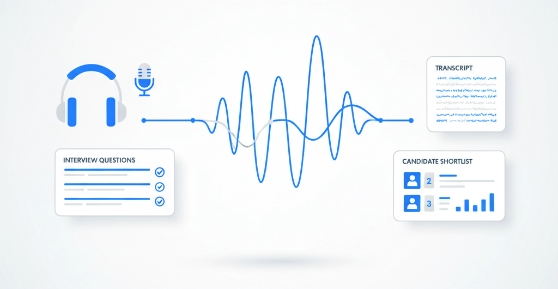
An AI audio interview is a structured, voice-only interview in which an AI agent speaks with a candidate — usually over a phone call. It asks role-specific questions, listens to answers, asks follow-ups, and produces a transcript, summary and evaluation that recruiters review before deciding who moves forward. It supports initial screening rather than replacing a human hiring decision.
AI audio interviews use a spoken conversation to gather information relevant to a role. A hiring team sets the questions and evaluation criteria; the AI agent conducts the initial conversation and organises the candidate’s responses for a recruiter.
Unlike a recorded answer to a fixed prompt, a conversational interview can ask relevant follow-up questions. The quality of those follow-ups and the resulting evaluation depends on the software, the role setup and the candidate’s call experience.
AI audio interview vs AI video interview vs chatbot screening
An audio interview is voice-only and can take place by phone without a camera. A video interview adds a visual component when that is relevant to the role or interview stage. Chatbot screening collects written responses instead of spoken answers. Each format serves a different candidate experience and assessment need.
How AI Audio Interviews Work
- The hiring team sets up the role, screening questions and relevant criteria.
- The candidate is invited to an interview or receives a call within the configured workflow.
- The AI agent conducts a structured voice conversation and asks appropriate follow-ups.
- The conversation is transcribed and evaluated against the criteria set by the hiring team.
- A recruiter reviews the summary, responses and suggested shortlist.
- Candidates who move forward continue to a human-led interview or next round.
Benefits for Recruiters and Hiring Teams
First-round candidate screening
Handle repeatable initial questions through a configured voice conversation before recruiter review.
Structured interviews
Apply role-relevant questions and criteria consistently while allowing useful follow-ups.
Less repetitive calling
Give recruiters more time for deeper interviews, candidate relationships and decisions.
High-volume hiring support
Organise initial conversations when many applicants need to be contacted and screened.
Candidate convenience
Offer a phone-based conversation without requiring an app, written form or camera.
Language accessibility
Where supported, let candidates discuss their experience in a language they are comfortable speaking.
Reviewable records
Provide transcripts, recordings and summaries that recruiters can revisit alongside an evaluation.
Limitations to Consider
- AI audio interviews are not a substitute for in-depth conversations or nuanced senior-role interviews.
- Call connectivity, background noise and network quality can affect the conversation and transcript.
- Some candidates prefer speaking directly with a person; provide a clear path for human support.
- Poorly designed questions can produce information that is incomplete or irrelevant to the role.
- Evaluation requires human review and ongoing monitoring for unfair or biased outcomes.
- Teams must address notice, consent, purpose limitation and security obligations under applicable privacy law, including India’s Digital Personal Data Protection Act, 2023.
Where AI Audio Interviews Fit
High-volume frontline hiring
Collect comparable first-round answers from applicants across locations before human review.
Explore high-volume screeningBPO and customer support
Discuss availability, role expectations and communication through a spoken initial conversation.
Retail hiring
Ask about store experience, location preferences and availability for frontline roles.
Explore retail hiringBFSI sales
Screen for relevant sales experience and role requirements before a recruiter follows up.
Explore BFSI hiringStaffing agencies
Organise initial qualification so consultants can focus on suitable candidates and clients.
Explore agency workflowsCampus and fresher pre-screens
Gather initial responses before more detailed assessments or human interviews.
Explore campus hiringRegional hiring
Where language coverage is available, reach candidates who prefer a supported regional language.
Explore regional hiringAI Audio Interviews vs Traditional Phone Screening
AI audio interviews can help with repeatable first-round conversations. Recruiter-led calls remain valuable for nuance, relationships and complex decisions.
| Consideration | AI audio interview | Traditional phone screening |
|---|---|---|
| Scheduling | Can invite or call candidates within a configured workflow. | Allows personal coordination around recruiter and candidate availability. |
| Consistency of questions | Uses configured role questions and evaluation criteria. | Can adapt freely, though questions may differ between interviewers. |
| Capacity | Supports multiple initial conversations through an automated workflow. | Depends on the recruiting team’s available calling time. |
| Recruiter time | Takes on repeatable first-round questions for later review. | Requires a recruiter’s direct time for every call. |
| Documentation | Can provide recordings, transcripts and structured summaries. | Depends on the recruiter’s notes and documentation process. |
| Language coverage | Depends on demonstrated support for the needed languages and accents. | Depends on the languages spoken by available recruiters. |
| Candidate experience | Offers a voice conversation without an app or camera; some candidates prefer a person. | Offers immediate human contact and a personal point of connection. |
| Depth and judgement | Useful for configured initial criteria; requires human review. | Better suited to nuance, rapport and sensitive follow-up. |
| Best for | Repeatable first-round screening across larger applicant pools. | Senior roles, deeper assessment, relationship-building and hiring decisions. |
Hear an AI audio interview
Explore a voice sample or book a demo to discuss first-round screening for your roles.
What to Look for in AI Audio Interview Software
- Role-specific question setup
- Natural follow-ups and interruption handling
- Indian language and mixed-language support where needed
- Accessible transcripts and call recordings
- Evaluation criteria controlled by the hiring team
- Shortlisting that recruiters can review
- Integration with your ATS workflow
- Retries and rescheduling for missed calls
- Clear consent, retention and privacy controls
How Mishuk Labs Approaches AI Audio Interviews
Mishuk Labs is an AI recruitment platform for candidate calling and voice-based candidate screening. Its AI voice recruiter calls candidates, runs role-specific screening conversations in Hindi, English and other supported Indian languages, and follows up on answers. It scores and shortlists candidates for recruiters to review.
The platform also offers AI video interviews when a visual round is needed. The aim is to take repetitive first-round calls off recruiters’ schedules while keeping people responsible for reviewing candidates and making final hiring decisions.
Learn about multilingual voice recruitingRead customer storiesFrequently Asked Questions
About Mishuk Labs
Mishuk Labs is an AI recruitment technology platform operated by Hireonix Apexinfo Private Limited. Its products include AI Phone Calling for candidate screening, AI Video Interviews and AI Voice Exit Interviews.
Founded by Pintu Shaw, Mishuk Labs works with employers and recruitment agencies across India.