
The short answer
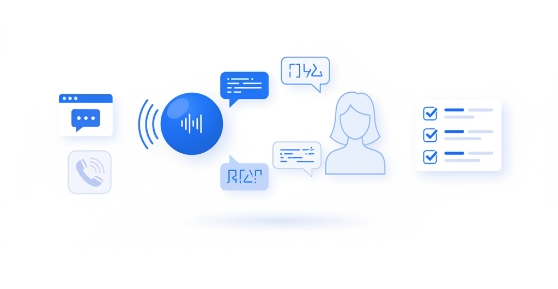
Conversational AI in recruitment uses AI systems that understand and respond to candidates in natural language — by voice or text. It can take on repeatable outreach, first-round phone screening and follow-ups, and organise answers for review. Time saved depends on volumes, connection rates and recruiter review capacity; recruiters make hiring decisions.
What Is Conversational AI in Recruitment?
A conversational system does more than deliver a recorded message or present a fixed menu. It interprets what a candidate says or types, keeps track of the current question and chooses an appropriate next response. [Jurafsky & Martin] In hiring, that might mean recognising a request to call later, clarifying a joining date or answering a question using approved job information.
For a voice conversation, speech recognition turns spoken words into text. Language understanding identifies likely intent and relevant context; dialogue management decides what to ask next. Response generation prepares the reply, and speech synthesis speaks it aloud. [Jurafsky & Martin] Each stage can make mistakes, particularly when audio is unclear, [Radford et al. 2022] [Svarah] so the resulting record should remain reviewable.
Text-based chatbots use a written interface instead of speech recognition and synthesis. [Jurafsky & Martin] They can be useful for application-status questions, FAQs and scheduling. AI voice agents use the phone channel for a spoken, two-way exchange. Neither format is inherently right for every applicant: choose the channel according to the role, the people applying and the work the conversation needs to accomplish.
Key definitions
- Conversational AI
- Technology that interprets natural-language input and produces a contextually relevant response across turns.
- AI voice agent
- A system that listens and speaks during a phone conversation, following a configured hiring workflow.
- Chatbot
- A text-based conversational interface, often used for questions, updates or scheduling.
- Intent
- The action or meaning inferred from a candidate’s words, such as asking for a callback.
- Contextual follow-up
- A next question informed by an earlier answer, rather than an unrelated scripted prompt.
- Code-mixing
- Using more than one language in one conversation, such as Hindi–English code-mixing. [Sharma et al. 2020]
How AI Voice Agents Work in Recruitment
Reach applicants through an appropriate process
A hiring team provides contact details collected for recruitment and configures when outreach is permitted. An AI voice agent contacts those applicants; it does not source candidates. A missed call or request for another time should have a defined next step. Retries run only in configured calling windows that respect recorded preferences. [TRAI TCCCPR amendment 2025]
Give notice and disclose AI involvement
Before calling, the employer should give candidates notice of what data is collected and why, and obtain and record consent — or confirm with counsel that a listed legitimate use applies. [DPDP Act 2023] These DPDP duties commence on 13 May 2027; designing for them now avoids rework. [G.S.R. 843(E)] A verbal “yes” on the call is not by itself a substitute for that notice and consent. [DPDP Act 2023] How the call discloses AI involvement and names the organisation is configured and agreed during onboarding, and the candidate should have a route to a person or another time.
Ask questions tied to the opening
Recruiters supply the role description, requirements and screening questions. [Levashina et al. 2014] A support role might call for shift availability and language comfort; a technical role might begin with stated experience and notice period before a specialist assesses technical depth.
Clarify answers in context
If a candidate gives an approximate date or an incomplete answer, the agent can ask a configured follow-up. [Sample conversation] Dialogue context helps it avoid restarting the script, [Jurafsky & Martin] although uncertain interpretations still need to be flagged rather than silently treated as facts.
Address questions about the role
The conversation can answer questions covered by approved job information, such as location or expected shifts. When the information is unavailable or a question needs judgement, the safer response is to record it for a recruiter instead of inventing an answer.
Capture responses against job criteria
The system records what was said and organises responses against criteria chosen by the hiring team. An evaluation can suggest which conversations need attention, but a missing answer, poor connection or ambiguous statement must not become an automatic rejection.
Hand the conversation to a recruiter
A summary and the underlying answers give a reviewer a starting point for the next step. Recruiters can verify details, correct misunderstandings, speak with the candidate and decide who advances.
Illustrative example — not a customer deployment
Consider a staffing firm hiring customer support associates in Hyderabad. An applicant moves between Telugu, Hindi and English, then says, “I can join after Diwali.” A well-configured agent asks for an exact available date and preferred shift rather than assuming when the festival ends. If it cannot confidently understand the reply, it marks the date for a recruiter to confirm.
Illustrative example: from answer to recruiter review
Continuing the hypothetical Hyderabad support-associate screen. The hiring team configured each requirement before calling; evaluations are suggestions the recruiter reviews and can override.
| Criterion | Configured requirement | Candidate said | Captured value | Evaluation | Recruiter next step |
|---|---|---|---|---|---|
| Availability | Able to join within 30 days of offer | I can join after Diwali. | After Diwali — exact date not given | Needs confirmation | Confirm exact joining date |
| Shift | Night shifts (10 pm–7 am) and weekend availability | Night shift is fine, weekends also okay. | Night shift: yes; weekends: yes | Meets stated requirement | None — recruiter may still confirm |
| Language comfort | Comfortable taking calls in Telugu or Hindi; working English | Telugu and Hindi are easy, English I manage. (Switches between languages.) | Self-reported comfort: Telugu and Hindi easy; English 'I manage' | Self-reported — proficiency not assessed | Assess spoken English in the next round |
| Location | Able to work from the Hitech City office | [unclear audio] | Not captured — audio unclear | Missing — not a rejection | Call back to confirm |
Suggested status: recruiter review needed. Two items need confirmation and language comfort is self-reported only; no automatic rejection.
Benefits of Conversational AI for Recruiters
Treat these as hypotheses to test in a pilot against your own baseline, not guaranteed outcomes.
A quicker first conversation
Configured outreach can begin while applications are still current. Whether this shortens time to first contact depends on application volumes, connection rates and how quickly recruiters review completed conversations.
How to measure: Median hours from application to first completed conversation, compared with your current process.
Less repetitive manual calling
Introductions, routine availability questions and callback requests need not occupy every recruiter calling slot. People remain responsible for exceptions, relationship-building and decisions.
How to measure: Recruiter hours spent on first-round calls per hire, before and during the pilot.
More accessible language choices
Where a workflow supports them, spoken language options can let applicants answer more comfortably. Teams should test actual accents and Hindi–English code-mixing rather than assume a language label guarantees understanding. [IndicVoices] [Svarah] [Sharma et al. 2020]
How to measure: Completion rate by language, stating the denominator (connected vs all candidates).
Capacity during hiring surges
Separate first-round conversations can run in parallel. That helps teams organise a busy queue, provided they also plan for consent, follow-up and human review.
How to measure: Applications reaching a completed first conversation within your target window during peak weeks.
A consistent starting point
Applicants for the same opening can receive the same core job-related questions, with room for relevant clarification. Consistency supports comparison [Levashina et al. 2014] ; it does not, by itself, remove bias.
How to measure: Share of completed screens covering all required questions.
Candidate-friendly timing
Configured calling windows and rescheduling paths can reduce missed connections. [TRAI TCCCPR amendment 2025] A candidate who cannot talk now should not be treated as uninterested.
How to measure: Callback and reschedule requests completed, and missed-call rate by calling window.
Documentation recruiters can inspect
Structured outcomes and summaries make it easier to find unanswered questions and prepare for a human conversation. Reviewers still need access to the underlying evidence.
How to measure: Share of outcomes recruiters change after reviewing the underlying answers.
AI Voice Agents vs Traditional Calling vs Chatbots
These channels solve different communication problems. The best choice depends on whether applicants are likely to answer a phone call, use a written interface or value a personal recruiter relationship.
| Consideration | AI voice agents | Traditional recruiter calling | Recruitment chatbots |
|---|---|---|---|
| Interaction style | Spoken, two-way conversation within a configured workflow. | A person can adapt freely during a live call. | Written exchange through a messaging or web interface. |
| Reach | Uses the phone channel; no candidate app or internet session is needed for a standard call. | Also reaches candidates by phone, subject to recruiter availability. | Usually needs a suitable device, connectivity and access to the chat channel. |
| Frontline and blue-collar roles | Useful when a phone call is the familiar primary channel. | Useful when personal explanation or reassurance matters. | Useful for applicants comfortable completing steps in writing. |
| Languages and dialects | Can support configured spoken languages; accents and code-mixing require testing. | Depends on the caller’s language skills. | Can handle supported written languages; literacy and typing preferences matter. |
| Follow-up depth | Can clarify within its configured context and approved information. | Can explore unexpected detail and sensitive circumstances. | Well suited to short written clarifications and routine questions. |
| Scalability | Can hold separate configured calls in parallel. | Call volume depends on available recruiter time. | Can handle many written exchanges at once. |
| Recruiter effort | Requires setup, exception handling and review of answers. | Requires a recruiter for each conversation and its notes. | Requires setup and escalation for questions it cannot resolve. |
| Candidate experience | A spoken option for applicants who prefer talking to typing. | Direct human rapport and immediate judgement. | Convenient for asynchronous FAQs, status updates and scheduling. |
| Best for | High-volume first-round screening when phone is a primary channel, as is common in many Indian hiring workflows. | Senior, passive or relationship-heavy roles and sensitive discussions. | FAQs, application status and scheduling for applicants comfortable online. |
Hear a recruiter-led voice screen
Explore how a configured voice conversation can collect first-round answers for human review.
Use Cases Across Industries
Conversational AI for recruiters works best when each opening has a clear purpose for its first exchange. A useful screen collects relevant information; it does not attempt to complete every assessment in one call.
IT recruitment
Ask about availability, notice period and stated skills before a specialist-led technical round. Keep technical claims open to verification.
Read: AI interviewer software and ATS integrationCustomer story: Protean technical phone screeningBFSI hiring
Discuss location, relevant frontline experience and interview availability while preserving a clear route for recruiter review.
Read: AI voice recruitment for BFSI hiringCustomer story: NBFC multilingual frontline screeningRetail
Clarify store preference, shifts and customer-facing experience during an application surge. For one documented example, see the V2 Mart deployment below.
Read: AI calling for retail hiringCustomer story: V2 Mart store manager hiringManufacturing
Collect site preference, shift availability and relevant work history before a human discusses practical requirements.
Read: AI for blue-collar manufacturing hiringBPO and call centers
Ask about language comfort and shift readiness, without treating a short call as a complete assessment of communication skills.
Read: AI audio interviews for recruitersStaffing agencies
Keep client-role criteria distinct and pass documented answers and callback requests to the responsible consultant.
Read: best AI calling software for agenciesCustomer story: Milestone Career agency callingDeployment example: Store Manager hiring at V2 Mart Retail
Figures from one deployment. The time saving is a Mishuk Labs estimate — not a benchmark, time study or independent audit.
V2 Mart Retail used Mishuk Labs AI voice calling for high-volume Store Manager hiring across multiple locations in India, with screening in Hindi and English, automated shortlisting and WhatsApp/SMS follow-ups. Recruiters ran final interviews and made hiring decisions. [V2 Mart case study]
| Metric | Value | Basis |
|---|---|---|
| Use case and role | Retail · Store Manager, multi-location India | Deployment description |
| Languages | Hindi and English | Deployment description |
| AI screening calls | 900 | Call count from the deployment |
| Unique candidates, connected, completed | Not published | Not part of the published case study; we do not estimate them |
| Candidates shortlisted | Not published | Not part of the published case study; we do not estimate it |
| Campaign duration | Not published | Not reported |
| What recruiters received per screen | Call recording, original-language transcript, full English translation, structured summary and score, ATS or spreadsheet export | Product output for each completed screen |
| Recruiter time saved | ~150 hours (illustrative estimate calculated by Mishuk Labs) | Calculated by Mishuk Labs: 900 calls × an assumed 10 minutes of recruiter effort per manual call. Not time-tracked or independently verified. |
How the time saving was calculatedAssumption
Illustrative estimate calculated by Mishuk Labs: approximately 150 hours, assuming 10 minutes of recruiter effort per manual call (900 calls × 10 minutes ÷ 60). The 10-minute figure is Mishuk Labs' assumption for dialling, conversation, breaks and notes; it was not supplied by V2 Mart, time-tracked or independently verified.
Limitations
- One customer, one role and two languages; results will differ by role, region and candidate list.
- The time saving is a Mishuk Labs calculation based on an assumption, not a figure reported or measured by V2 Mart; nothing here is independently audited.
- Without connection and completion counts, the example cannot show reach or drop-off.
- No candidate-feedback or quality-of-hire data was collected, so the article makes no claim about either.
Limitations of Conversational AI in Recruitment
A noisy line, unfamiliar accent or mixed-language answer can affect transcription and interpretation. [Radford et al. 2022] [Svarah] [Koenecke et al. 2020] [Sharma et al. 2020] Even a clearly transcribed sentence may contain humour, hesitation or nuance that a system misreads. Candidates need a way to repeat or correct an answer, and reviewers need to see uncertainty. These studies describe speech recognition in general and on Indian speech datasets; they are not measurements of Mishuk Labs' own accuracy, which has not been independently benchmarked. Test any provider on your own candidates' speech.
A voice agent cannot reproduce the trust a skilled recruiter builds in a senior, passive or sensitive conversation. Its performance also depends on the questions, role information and escalation rules the team provides. Poorly designed prompts simply make a weak screening process repeatable.
Some people will not want to speak with AI. Offer a human contact path, monitor the experience after launch and examine outcomes for unfair patterns. [Koenecke et al. 2020] Suggested evaluations can help organise review, but final hiring decisions belong to people. A review of 18 vendors of algorithmic pre-employment assessments found limited public disclosure on validation and bias testing, so ask providers for evidence rather than assume it. [Raghavan et al. 2020]
Best Practices for Conversational AI in Recruitment
Be clear about AI and consent
From 13 May 2027, DPDP processing must rest on consent given after notice, or a legitimate use in section 7; whether section 7(i) covers prospective applicants needs counsel. [DPDP Act 2023] [G.S.R. 843(E)] Recommended now: disclose AI involvement and the call's purpose, record agreement to continue and respect a request not to continue.
Make human contact possible
Give candidates a practical way to ask for a person, correct a misunderstanding or arrange a more suitable time.
Ask only job-related questions
Configure questions around genuine role requirements. Define what the agent may clarify and when it must hand a question back. [Levashina et al. 2014]
Test real speech
Pilot with the languages, accents, background noise and code-mixing applicants actually use, including Hindi–English code-mixing where relevant. [Svarah] [Sharma et al. 2020] [Radford et al. 2022]
Keep decisions human
Have recruiters inspect underlying answers and uncertain interpretations before acting on a suggested priority.
Protect candidate data
Set access and retention rules for transcripts and recordings. Today, IT Act s. 43A security practices apply; DPDP Rules on security, breach and retention (Rules 3 and 5–16) apply from 13 May 2027. [DPDP Rules 2025] [G.S.R. 843(E)]
Monitor fairness and calling practices
Monitor outcomes by language, region and other candidate groups. [Koenecke et al. 2020] Ask providers for validation and bias-testing evidence. [Raghavan et al. 2020] Promotional calls use the 140 series. The 1600 series is limited to specified BFSI and government entities, and 1601 Phase I covers only utilities and courier/logistics, so confirm with your telecom provider how recruitment calls are classified and which series to use rather than assuming 1600 or 1601 applies. [TRAI TCCCPR amendment 2025] [PIB on 1600] [PIB on 1601 Phase I]
Compare a pilot with your own baseline
Track completion, callbacks, corrections and recruiter review effort alongside speed. Use what you learn to adjust questions and escalation paths.
Legal references here are general information, not legal advice.
DPDP and TRAI: What Applies Now and What Is Coming
This section is general information as of 11 November 2026, not legal advice. Have an Indian privacy lawyer review your candidate-calling workflow before launch.
Applies now (11 November 2026)
Until 13 May 2027, section 43A of the Information Technology Act, 2000 and its 2011 rules on reasonable security practices continue to govern sensitive personal data, such as financial or medical details a candidate may share. [DPDP Act 2023] [G.S.R. 843(E)] Automated calls over Indian telecom networks fall under TRAI's TCCCPR: senders register with an access provider, respect customers' recorded preferences, and use the 140 series for promotional calls. [TRAI TCCCPR amendment 2025] The 1600 series is limited to service and transactional calls by RBI-, SEBI-, IRDAI- and PFRDA-regulated entities and government bodies, and Phase I of the 1601 series covers only utilities and courier/logistics entities. [PIB on 1600] [PIB on 1601 Phase I] [TRAI 1601 direction] TRAI's numbering framework distinguishes promotional and service/transactional calls. The cited guidance does not establish a dedicated numbering category for recruitment screening calls. Recruitment teams should confirm the applicable classification, registration and numbering requirements with their telecom provider before deploying automated calls, and have an Indian telecom-compliance lawyer review this before relying on it.
Commencing later under the DPDP Act
From 13 May 2027, digital personal data may be processed with consent given after a notice describing the data and purpose, or for one of the 'certain legitimate uses' in section 7; Data Fiduciary duties and DPDP Rules 3 and 5–16 on notice, security, breach and retention commence the same day, and IT Act s. 43A is omitted. [DPDP Act 2023] [G.S.R. 843(E)] [DPDP Rules 2025] Section 7(i) covers employment purposes, but whether it extends to prospective applicants who are not yet employees is a legal interpretation that needs counsel; do not assume it does. [DPDP Act 2023] Consent-manager provisions (s. 6(9), Rule 4) apply from 13 November 2026. [G.S.R. 843(E)] [DPDP Rules 2025]
Recommended practice today (not yet a DPDP legal requirement)
Mishuk Labs recommends — and supports in configuration — telling candidates who is calling and why, disclosing AI involvement, recording the candidate's agreement to continue, honouring requests to stop or reschedule, and setting access and retention limits for recordings and transcripts. Designing this way now reduces rework when DPDP duties commence; it is a recommendation, not a statement that these duties already apply.
| Requirement | Status on 11 Nov 2026 | Source |
|---|---|---|
| DPDP definitions and Data Protection Board (ss. 1(2), 2, 18–26) | In force since 13 Nov 2025 | [G.S.R. 843(E)] |
| Consent manager provisions (s. 6(9), Rule 4) | In force from 13 Nov 2026 | [G.S.R. 843(E)] [DPDP Rules 2025] |
| Notice, consent, legitimate uses and Data Fiduciary duties (ss. 3–17); DPDP Rules 3 and 5–16 | Not yet in force — commence 13 May 2027 | [G.S.R. 843(E)] [DPDP Rules 2025] |
| IT Act, 2000 s. 43A (reasonable security practices) | Applies until omitted by DPDP s. 44(2) on 13 May 2027 | [DPDP Act 2023] [G.S.R. 843(E)] |
| TRAI TCCCPR: sender registration, recorded customer preferences, 140 series for promotional voice calls | In force | [TRAI TCCCPR amendment 2025] |
| 1600 series: service and transactional calls by RBI-, SEBI-, IRDAI- and PFRDA-regulated entities and Central/State Government | In force for those entities only | [TRAI TCCCPR amendment 2025] [PIB on 1600] |
| 1601 series: service and transactional calls, implemented in phases | Phase I (utilities, courier and logistics) — migration due by 8 Nov 2026; other sectors not yet notified | [TRAI 1601 direction] [PIB on 1601 Phase I] |
| Classification of recruitment screening calls | Not specified by TRAI — confirm classification, sender registration and series with your telecom provider; do not assume 1600 or 1601 | [TRAI TCCCPR amendment 2025] |
A Short Checklist for Choosing a Solution
Ask a provider to demonstrate a realistic opening, including an unclear answer and a request to speak with a person. A polished sample alone will not show how the workflow behaves in daily use.
- Languages: can you test the accents and Hindi–English code-mixing your applicants use?
- Conversation quality: how are interruptions, uncertainty and corrections handled?
- Customisation: who controls questions, approved answers and escalation rules?
- ATS integration: which fields can move through available APIs and permissions?
- Security: who can access data, and how are retention and deletion managed?
- Calling compliance: Confirm the classification of recruitment calls, sender registration and the appropriate numbering series with your telecom provider. Do not assume recruitment screening calls qualify for the 1600 or 1601 service and transactional series.
- Reporting: can recruiters inspect the evidence behind each outcome?
- Pricing model: what usage and operational work does the model include?
- Implementation: who owns the pilot, review process and ongoing monitoring?
Where Mishuk Labs Fits
Mishuk Labs is an AI-powered recruitment platform offering AI voice screening with role-specific questions and contextual follow-ups. Conversations are supported in 14+ Indian languages. Candidate responses are evaluated and organised for recruiter review; how the call discloses AI involvement is configured with each customer.
Teams can use AI video interviews for later rounds. ATS integration is available through APIs, with fields configured during onboarding according to available API permissions. Recruiters inspect the evidence and make final hiring decisions.
Read: multilingual AI voice recruiterRead: AI interviewer ATS integrationRead: AI video interviews for campus recruitmentConclusion
Conversational AI in recruitment is most valuable when the channel fits the candidate and the conversation has a defined, reviewable purpose. Voice agents can handle repeatable first-round phone exchanges; chatbots can support written updates; recruiters provide judgement and relationships. Start with a small, representative pilot, make uncertainty visible and let people decide what happens next.
About the author
Pintu Shaw
Founder, Mishuk Labs (Hireonix Apexinfo Pvt Ltd)
Pintu works with recruitment teams across India on high-volume first-round screening and built Mishuk Labs' multilingual AI voice screening.
Read the founder storyFrequently Asked Questions
What is conversational AI in recruitment?
Conversational AI in recruitment uses systems that interpret and respond to candidates in natural language, by voice or text. It can support outreach, initial screening, follow-ups and organisation of answers. Hiring teams define the role and workflow; recruiters review the evidence, resolve exceptions and make decisions about who advances.
How are AI voice agents different from recruitment chatbots?
An AI voice agent listens and speaks during a phone conversation, while a chatbot exchanges written messages through a web or messaging interface. Voice can suit applicants who prefer talking or primarily use a phone. Chatbots can be convenient for FAQs, application updates and scheduling. Both need clear escalation paths. [Jurafsky & Martin]
Can conversational AI replace recruiters?
No. It can take on repeatable introductions, first-round questions and routine follow-ups, but it may misunderstand speech or miss important context. [Radford et al. 2022] [Svarah] Recruiters set criteria, inspect answers, handle sensitive situations and make hiring decisions. Personal contact remains particularly important for senior, passive or relationship-led candidates.
How does conversational AI evaluate candidates?
A hiring team configures job-related criteria and questions. The system captures answers, organises them against those criteria and may suggest which conversations need review. A suggestion is not a final decision: recruiters should examine the underlying responses, check unclear audio or missing information and correct misunderstandings before acting. [Raghavan et al. 2020]
Does conversational AI support Indian languages and code-mixing?
Support varies by product, configuration and the speech being tested. Mishuk Labs supports voice-based screening in 14+ Indian languages. Teams should pilot the accents, Hindi–English code-mixing and noisy environments their applicants actually use, and give candidates a way to clarify or correct misunderstood answers. [IndicVoices] [Svarah] [Sharma et al. 2020]
Is conversational AI suitable for blue-collar and frontline hiring?
It can suit repeatable first-round conversations when a phone call is a practical channel for applicants. Questions about location, shifts or availability can be collected for recruiter review. Teams should test language accessibility, call timing and candidate preferences; a short automated call is not a complete assessment of a person.
How does conversational AI integrate with an ATS?
Where APIs and permissions allow, configured candidate details, call statuses and screening outcomes can move between a conversational workflow and an applicant tracking system. The exact fields and timing depend on the systems and onboarding configuration. Confirm error handling and where recruiters can inspect the answers behind an outcome.
How should candidates be informed they are speaking with AI?
Before calling, the employer should give notice of the data collected and why, and obtain and record consent — or confirm with counsel that a listed legitimate use under the DPDP Act applies. [DPDP Act 2023] These DPDP duties commence on 13 May 2027. [G.S.R. 843(E)] How the call identifies itself as AI, names the organisation and explains its purpose should be agreed during setup, with a route to a human and an option to stop or reschedule. This is general information, not legal advice.
Sources
- Daniel Jurafsky and James H. Martin, “Chatbots & Dialogue Systems,” Speech and Language Processing, 3rd ed. draft, Ch. 15 (Jan 2023) — TextbookSupports: Describes dialogue-system architecture, including speech recognition, language understanding, dialogue state and management, generation and synthesis, and tracking context across turns.
- Alec Radford, Jong Wook Kim, Tao Xu, Greg Brockman, Christine McLeavey and Ilya Sutskever, “Robust Speech Recognition via Large-Scale Weak Supervision,” arXiv:2212.04356 (2022) — ResearchSupports: English ASR word error rates rise as added background noise increases.
- Tahir Javed et al., “Svarah: Evaluating English ASR Systems on Indian Accents,” Interspeech 2023 — ResearchSupports: ASR systems still make notable errors on Indian-accented English in a study of 117 speakers from 65 locations.
- Yash Sharma, Basil Abraham, Karan Taneja and Preethi Jyothi, “Improving Low Resource Code-Switched ASR Using Augmented Code-Switched TTS,” Interspeech 2020 — ResearchSupports: Hindi–English code-switched speech is harder for ASR, especially at language-switch points.
- Telecom Regulatory Authority of India, “Telecom Commercial Communications Customer Preference (Second Amendment) Regulations, 2025,” 12 Feb 2025 — Regulation (India)Supports: Addresses sender registration and customer preferences, the 140 series for promotional voice calls, and the 1600 series (or another series allotted for the purpose) for service and transactional voice calls.
- Digital Personal Data Protection Act, 2023 (No. 22 of 2023), official text, Ministry of Electronics and Information Technology, Government of India — Law (India)Supports: Sets out notice (s. 5), consent (s. 6), certain legitimate uses including employment (s. 7(i)), Data Fiduciary duties (s. 8), and omission of IT Act s. 43A (s. 44(2)).
- Ministry of Electronics and Information Technology, notification G.S.R. 843(E), 13 Nov 2025, appointing commencement dates under the Digital Personal Data Protection Act, 2023 — Law (India)Supports: Appoints 13 Nov 2025 for ss. 1(2), 2, 18–26, 35, 38–43 and 44(1), (3); 13 Nov 2026 for ss. 6(9) and 27(1)(d); and 13 May 2027 for ss. 3–5, 6(1)–(8), (10), 7–17, 27 except 27(1)(d), 28–34, 36–37 and 44(2).
- Julia Levashina, Christopher J. Hartwell, Frederick P. Morgeson and Michael A. Campion, “The Structured Employment Interview: Narrative and Quantitative Review of the Research Literature,” Personnel Psychology 67(1) (2014) — ResearchSupports: Consistent, job-related questions are associated with more reliable and valid interviews.
- Mishuk Labs AI phone calling page — sample screening conversation — Product demonstrationSupports: Shows an illustrative transcript with a contextual follow-up and a language switch; it is not performance evidence.
- Tahir Javed et al., “IndicVoices: Towards building an Inclusive Multilingual Speech Dataset for Indian Languages,” Findings of ACL 2024 — ResearchSupports: Indian-language ASR needs diverse speech data across 22 languages.
- Mishuk Labs customer story: V2 Mart Retail — Customer storySupports: Store Manager hiring deployment with 900 AI screening calls. The ~150 recruiter hours saved figure is an illustrative estimate calculated by Mishuk Labs (900 calls × an assumed 10 minutes of recruiter effort per manual call); not time-tracked or independently verified.
- Allison Koenecke et al., “Racial disparities in automated speech recognition,” PNAS 117(14) (2020) — ResearchSupports: Five commercial ASR systems had different error rates across speaker groups in US English; the study did not measure Indian speech.
- Manish Raghavan, Solon Barocas, Jon Kleinberg and Karen Levy, “Mitigating Bias in Algorithmic Hiring: Evaluating Claims and Practices,” FAT* 2020 — ResearchSupports: A review of 18 vendors of algorithmic pre-employment assessments found limited public disclosure on validation and bias testing.
- Digital Personal Data Protection Rules, 2025, G.S.R. 846(E), 13 Nov 2025, Ministry of Electronics and Information Technology, Government of India — Law (India)Supports: Rules 1–2 and 17–21 apply from 13 Nov 2025, Rule 4 from 13 Nov 2026, and Rules 3 and 5–16, covering notice, security, breach and retention, from 13 May 2027.
- Press Information Bureau, clarification on the 1600 numbering series for BFSI and government service and transactional calls — Government release (India)Supports: The 1600 series is for service and transactional calls by entities regulated by RBI, SEBI, IRDAI and PFRDA, and by Central and State Government entities.
- Press Information Bureau, "TRAI issues direction for 1601 numbering series for service and transactional voice calls — Phase I: utilities, courier and logistics" (Aug 2026) — Government release (India)Supports: Phase I of the 1601 series covers utilities and courier/logistics entities; 90-day migration; further sectors to be notified after review.
- Telecom Regulatory Authority of India, direction on allocation and operationalisation of the 1601 numbering series for service and transactional voice calls (Aug 2026) — Regulation (India)Supports: Direction of 10 Aug 2026 allotting the 1601 series for service and transactional voice calls, implemented in phases; Phase I covers utilities and courier/logistics entities only, with other sectors to be notified later.