
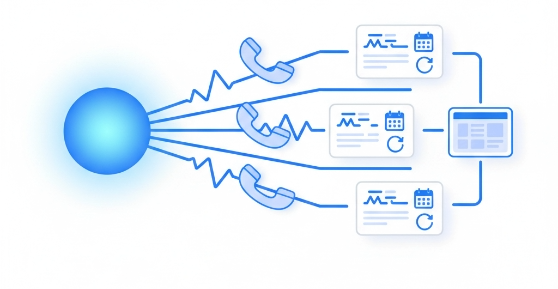
The short answer
An AI calling platform for recruitment is software that uses AI voice agents to call candidates, ask role-specific screening questions, capture their answers, handle callbacks and summarise each conversation for recruiter review. It can help teams reach candidates sooner, but whether shortlists actually arrive faster depends on volumes, connection rates and review capacity, and should be measured against your current process. Hiring decisions stay with recruiters.
What Is an AI Calling Platform for Recruitment?
Instead of assigning every routine first call to a recruiter, a hiring team configures a voice agent with an opening, role details, questions and next steps. The agent speaks with candidates whose contact details the team has provided, listens to answers and records what happened. It can clarify a response or handle a request to talk later within the configured workflow.
The platform then organises call outcomes for a person to review. A completed conversation might lead to an interview invitation; an uncertain answer might require a recruiter's follow-up. Unlike an IVR menu, a conversational agent interprets free-form answers and keeps track of context across turns. [Jurafsky & Martin] Calling automation extends a team's capacity to communicate, but it neither finds candidates nor determines who should be hired.
Key definitions
- AI calling platform
- Software for configuring, conducting and reviewing AI-assisted candidate phone conversations.
- AI voice recruiter
- A voice agent that explains a role, asks hiring questions and captures spoken responses.
- AI phone screening
- A first-round voice conversation focused on collecting answers against job criteria.
- Recruitment calling automation
- The coordination of candidate outreach, retries, follow-ups and call outcomes within a hiring workflow.
- Parallel calling
- Running separate configured candidate conversations at the same time, subject to capacity and calling rules.
How AI Recruitment Calling Works
Provide candidate data
The team uploads an applicant list or connects an ATS through an available API. Contact details should come from the team's own recruitment process; the platform is not a candidate-sourcing tool.
Configure the job
Recruiters set the job description, must-have criteria, questions, supported languages and permissible call windows. They also decide which answers warrant clarification or human attention.
Place automated calls
The agent introduces the organisation and the reason for calling; how it discloses AI involvement is agreed during onboarding. Retries run only inside configured calling windows that respect candidates' recorded preferences, and a candidate who cannot talk can request another time. [TRAI TCCCPR amendment 2025]
Hold a screening conversation
Candidates answer in their own words. The agent asks role-specific questions and, when configured, contextual follow-ups rather than forcing every response into a fixed menu. [Jurafsky & Martin] [Sample conversation]
Evaluate responses
The system maps captured answers to the team’s criteria and prepares a transcript or summary. Unclear audio, missing information and uncertain interpretations should remain visible.
Organise a shortlist
Call outcomes and suggested priorities help recruiters decide which applicants to examine first. Suitable candidates can move into scheduling or a later interview workflow after review.
Keep recruiters in control
A recruiter checks the underlying answers, corrects misunderstandings, follows up on exceptions and decides who advances. The platform supports that judgement rather than replacing it.
Illustrative example — not a customer deployment
An RPO team hiring collections executives for an NBFC across Lucknow and Patna configures conversations in Hindi, with Bhojpuri where the candidate prefers it, about two-wheeler access, knowledge of local areas and a realistic joining date. If an applicant asks for an evening callback, the workflow records and reschedules the request instead of treating the interrupted call as a rejection.
What the recruiter sees: one candidate, five criteria
Illustrative entries for the Lucknow collections-executive example, not real candidate records or measured model outputs. Requirements are configured by the hiring team; the recruiter can listen to the recording, read the original-language transcript and override any evaluation.
| Criterion | Configured requirement | Candidate said (translated from Hindi) | Captured | Evaluation | Recruiter next step |
|---|---|---|---|---|---|
| Two-wheeler access | Own or reliable access to a two-wheeler | Haan, apni bike hai — yes, I have my own bike. | Own two-wheeler: yes | Meets requirement | None |
| Driving licence | Valid two-wheeler licence before joining | Licence hai, but address purana hai. → follow-up "Is it valid?" → "Yes, valid till 2029." | Licence: valid (self-reported), old address | Needs recruiter check | Verify document before offer |
| Local area knowledge | Familiar with assigned Lucknow zones | Aliganj aur Kapoorthala achhe se jaanta hoon. | Knows Aliganj, Kapoorthala | Meets requirement | Confirm zone allocation |
| Language comfort | Comfortable speaking Hindi with customers | Hindi mein koi problem nahi. | Hindi comfort: yes — self-reported, not assessed | Self-reported — not assessed | Assess in recruiter interview |
| Joining date | Can join within 30 days | Diwali ke baad join kar sakta hoon. | Joining: after Diwali — date not confirmed | Date needs confirmation | Confirm exact date on callback |
Summary for recruiter: 2 requirements met, 2 need recruiter verification, 1 date unconfirmed. Suggested status: Hold for recruiter review — not auto-rejected.
Key Features of an AI Calling Platform for Recruitment
Capabilities vary by provider; confirm each one in a pilot rather than from a feature list.
Role-specific screening questions
Questions tied to the opening produce answers a recruiter can actually use.
Contextual follow-ups
A conversational agent tracks what has already been said and can ask a clarification, which helps distinguish an incomplete answer from a missing qualification. [Jurafsky & Martin]
Multilingual voice conversations
Supported languages let candidates speak more comfortably. Real accents and Hindi–English code-mixing still need testing, because speech recognition makes more errors on them. [Svarah] [Sharma et al. 2020] [IndicVoices]
Automated candidate evaluation
Criteria-based suggestions help order a review queue without making final decisions.
Call summaries and transcripts
Reviewers can inspect the evidence behind an outcome rather than rely on a label alone.
Parallel calling
Separate conversations can progress during an application surge without serial recruiter calls.
Interview scheduling
Where offered, availability capture and configured invitations reduce back-and-forth after an initial screen.
Reporting
Call statuses and completion patterns help teams spot workflow problems and unanswered follow-ups.
ATS integration
Available APIs can connect configured candidate and outcome fields to an existing hiring process; confirm which fields sync, in which direction and when.
Benefits for Recruiters
Treat these as hypotheses to measure in a pilot against your own baseline, not guaranteed outcomes.
Less manual calling
Repeatable introductions and first-round questions need not consume every recruiter calling slot. Recruiters can spend that time on context and candidate relationships.
How to measure: Recruiter hours spent on first-round calls, before and during the pilot.
Earlier initial screening
Configured outreach can start conversations soon after an application arrives. Whether screening actually happens sooner depends on application volumes, connection rates and how quickly recruiters review results.
How to measure: Median hours from application to first completed screen, compared with your current process.
More outreach capacity
Parallel conversations help a TA team, agency or RPO contact a larger applicant pool. Measure reach alongside consent, completion and candidate experience.
How to measure: Share of applicants reaching a completed first conversation, stating the denominator (all applicants vs connected calls).
Consistent screening
Core job-related questions stay comparable across applicants, with room for clarifying follow-ups; structured, consistent questions are associated with more reliable interviews. [Levashina et al. 2014] Consistency helps documentation but does not, by itself, remove bias.
How to measure: Share of completed screens that cover all required questions.
A workable high-volume queue
Call outcomes, callback requests and suggested priorities help teams handle surges without losing track of people who need a response.
How to measure: Callback requests completed, and applicants left without any response, per week.
Clearer candidate evidence
Summaries and transcripts make it easier to inspect what someone said, verify uncertain details and prepare for a more personal next conversation.
How to measure: Share of outcomes recruiters change after reviewing the underlying answers.
AI Calling vs Traditional Recruitment Calling
These approaches are complementary. Automated conversations suit repeatable early-stage work; a person is often better placed to build rapport, discuss sensitive circumstances or approach a senior or passive candidate.
| Consideration | AI calling | Traditional recruiter calling |
|---|---|---|
| Scalability | Can conduct separate configured conversations in parallel. | Capacity follows recruiter availability and time. |
| Recruiter workload | Collects routine first-round information for later review. | A recruiter handles each call and can assess context immediately. |
| Consistency | Uses a shared question set and configured follow-ups. | Adapts freely, though questions and notes may differ. |
| Candidate experience | Can offer a prompt conversation when timing and language fit. | Offers direct rapport and help with unusual concerns. |
| Cost structure | May be billed by call, minute or plan; review the complete model. | Primarily uses recruiter hours and operational capacity. |
| Availability and call windows | Can work within configured windows and record callback requests. | Depends on a person being available to call or return a call. |
| Documentation | Can prepare structured outcomes, summaries and transcripts. | Depends on how consistently the caller records notes. |
| Human oversight | Needs reviewers to check evidence and make decisions. | A person exercises judgement during the conversation. |
| Best fit | Repeatable outreach and early screening across an applicant pool. | Senior, passive, sensitive or relationship-led conversations. |
Hear a recruiter-led voice screen
Explore how a configured calling workflow can collect first-round answers for human review.
Deployment example: Store Manager hiring at V2 Mart Retail
Figures from one deployment. The time saving is a Mishuk Labs estimate — not a benchmark, time study or independent audit.
V2 Mart Retail used Mishuk Labs AI voice calling for high-volume Store Manager hiring across multiple locations in India, with screening in Hindi and English, automated shortlisting and WhatsApp/SMS follow-ups. Recruiters ran final interviews and made hiring decisions. [V2 Mart case study]
| Metric | Value | Basis |
|---|---|---|
| Use case and role | Retail · Store Manager, multi-location India | Deployment description |
| Languages | Hindi and English | Deployment description |
| AI screening calls | 900 | Call count from the deployment |
| Unique candidates, connected, completed | Not published | Not part of the published case study; we do not estimate them |
| Candidates shortlisted | Not published | Not part of the published case study; we do not estimate it |
| Campaign duration | Not published | Not reported |
| What recruiters received per screen | Call recording, original-language transcript, full English translation, structured summary and score, ATS or spreadsheet export | Product output for each completed screen |
| Recruiter time saved | ~150 hours (illustrative estimate calculated by Mishuk Labs) | Calculated by Mishuk Labs: 900 calls × an assumed 10 minutes of recruiter effort per manual call. Not time-tracked or independently verified. |
How the time saving was calculatedAssumption
Illustrative estimate calculated by Mishuk Labs: approximately 150 hours, assuming 10 minutes of recruiter effort per manual call (900 calls × 10 minutes ÷ 60). The 10-minute figure is Mishuk Labs' assumption for dialling, conversation, breaks and notes; it was not supplied by V2 Mart, time-tracked or independently verified.
Limitations
- One customer, one role and two languages; results will differ by role, region and candidate list.
- The time saving is a Mishuk Labs calculation based on an assumption, not a figure reported or measured by V2 Mart; nothing here is independently audited.
- Without connection and completion counts, the example cannot show reach or drop-off.
- No candidate-feedback or quality-of-hire data was collected, so the article makes no claim about either.
Use Cases Across Industries
A useful workflow starts with the questions a role genuinely requires. Industries differ, and a first call should never be mistaken for a complete assessment.
IT recruitment
Gather availability, stated skills and notice period before a specialist assesses technical depth.
Read: AI interviewer software and ATS integrationCustomer story: Protean technical phone screeningBFSI
Discuss location, frontline experience and interview availability for a recruiter’s review.
Read: AI voice recruitment for BFSI hiringCustomer story: bank frontline sales manager video interviewsNBFCs
Collect territory familiarity, self-reported language comfort and joining timelines across distributed openings.
Customer story: NBFC multilingual frontline screeningRetail
Ask about store preference, shifts and customer-facing experience during seasonal hiring. For one documented example, see the V2 Mart deployment below.
Read: AI calling for retail hiringCustomer story: V2 Mart store manager hiringManufacturing
Capture site preference, shift availability and relevant experience before a human follow-up.
Read: AI for blue-collar manufacturing hiringBPO and call centers
Discuss self-reported language comfort, schedules and prior service work without treating one call as a complete communication assessment.
Read: AI audio interviews for recruitersFrontline sales
Ask about territory, targets and travel requirements, then let recruiters inspect the answers.
Read: AI phone screening for recruitersCampus hiring
Coordinate initial interest and availability before an appropriate later-stage interview.
Read: AI video interviews for campus recruitmentAgencies and RPO teams
Keep each client role’s criteria separate and hand documented answers to the responsible consultant.
Read: best AI calling software for agenciesCustomer story: recruitment agency AI callingAI Calling for High-Volume Recruitment
When applications arrive in a batch, sequential calling can leave candidates waiting. A configured platform can run parallel conversations, organise batch outreach and put completed screens, missed calls and callback requests into distinct queues. Recruiters can then prioritise review without losing sight of unresolved cases.
Follow-up reminders help close the loop with people who could not speak initially. After a reviewed first-round call, a team may hand an appropriate candidate to a scheduled human interview or an AI video interview for a later round. Neither step removes the need for human assessment.
Illustrative example — not a customer deployment: a logistics team hiring delivery partners before a festive season might ask applicants about service area, licence and availability, then return evening callback requests to the queue. Calling windows, consent and a route to a person remain part of the workflow.
Read: AI voice recruitment for logistics hiringRead: AI interviewers for high-volume recruitmentHow to Choose an AI Calling Platform for Recruitment
Pilot a real opening with representative candidates rather than judging a platform only by a polished demonstration. Ask how it handles incomplete answers and what a recruiter can inspect afterward.
- Language support: test the languages applicants use, including Hindi–English code-mixing. [Svarah] [Sharma et al. 2020]
- Conversation quality: try real role terminology, interruptions, background noise and varied accents. [Radford et al. 2022] [Svarah]
- Customisation: confirm control over questions, criteria, introductions, AI disclosure and callback rules.
- ATS integration: establish which fields sync through available APIs, in which direction and when.
- Security and privacy: examine access controls, retention and deletion, how the provider meets current IT Act s. 43A security obligations, and how it will support DPDP duties that commence on 13 May 2027. [G.S.R. 843(E)] [DPDP Rules 2025]
- Calling compliance: Confirm the classification of recruitment calls, sender registration and the appropriate numbering series with your telecom provider. Do not assume recruitment screening calls qualify for the 1600 or 1601 service and transactional series. [TRAI TCCCPR amendment 2025] [PIB on 1600] [PIB on 1601 Phase I]
- Evidence: ask for validation and bias-testing evidence rather than assume it exists. [Raghavan et al. 2020]
- Scalability: discuss concurrent calls, scheduling constraints and operational limits.
- Reporting: verify that reviewers can inspect call outcomes and the evidence behind suggestions.
- Pricing: understand whether the model is per call, per minute or plan, and ask about total cost.
- Implementation: agree on onboarding, a small pilot, exception handling and a review process.
Challenges and Best Practices
Candidate notice and consent
Today: IT Act s. 43A and its rules govern sensitive personal data, and TRAI rules require calls to respect candidates' recorded preferences. [DPDP Act 2023] [TRAI TCCCPR amendment 2025] From 13 May 2027: DPDP processing must rest on consent given after notice, or on a legitimate use listed in section 7; whether section 7(i)'s employment use extends to prospective applicants needs counsel. [DPDP Act 2023] [G.S.R. 843(E)] Recommended now: tell candidates who is calling and why, record their agreement to continue and honour requests to stop or reschedule.
Privacy and data security
Today: apply reasonable security practices under IT Act s. 43A to recordings and transcripts. [G.S.R. 843(E)] From 13 May 2027: DPDP Rules on notice, security, breach and retention (Rules 3 and 5–16) apply. [DPDP Rules 2025] [G.S.R. 843(E)] Recommended now: limit access and define retention and deletion rules.
Language and accent differences
Noisy lines, Indian accents and code-mixed speech can increase speech-recognition errors. [Radford et al. 2022] [Svarah] [Sharma et al. 2020] These studies describe speech recognition in general; Mishuk Labs' own accuracy has not been independently benchmarked, so test with representative candidates and let them correct a misunderstood answer.
Bias mitigation
Use job-related criteria and monitor outcomes by language, region and other candidate groups; speech-recognition error rates have been shown to differ between speaker groups. [Koenecke et al. 2020] A review of 18 vendors of algorithmic pre-employment assessments found limited public disclosure on validation and bias testing, so ask providers for evidence. [Raghavan et al. 2020]
Transparent communication
Agree during onboarding how the call discloses AI involvement and its purpose, and offer human contact when needed. Promotional calls use the 140 series. The 1600 series is limited to specified BFSI and government entities, and 1601 Phase I covers only utilities and courier/logistics, so confirm with your telecom provider how recruitment calls are classified and which series to use rather than assuming 1600 or 1601 applies. [TRAI TCCCPR amendment 2025] [PIB on 1600] [PIB on 1601 Phase I]
Human hiring decisions
Treat suggested priorities as review aids. A recruiter should inspect the underlying evidence, resolve exceptions and remain responsible for consequential decisions.
Legal references here are general information as of 11 November 2026, not legal advice.
DPDP and TRAI: What Applies Now and What Is Coming
This section is general information as of 11 November 2026, not legal advice. Have an Indian privacy lawyer review your candidate-calling workflow before launch.
Applies now (11 November 2026)
Until 13 May 2027, section 43A of the Information Technology Act, 2000 and its 2011 rules on reasonable security practices continue to govern sensitive personal data, such as financial or medical details a candidate may share. [DPDP Act 2023] [G.S.R. 843(E)] Automated calls over Indian telecom networks fall under TRAI's TCCCPR: senders register with an access provider, respect customers' recorded preferences, and use the 140 series for promotional calls. [TRAI TCCCPR amendment 2025] The 1600 series is limited to service and transactional calls by RBI-, SEBI-, IRDAI- and PFRDA-regulated entities and government bodies, and Phase I of the 1601 series covers only utilities and courier/logistics entities. [PIB on 1600] [PIB on 1601 Phase I] [TRAI 1601 direction] TRAI's numbering framework distinguishes promotional and service/transactional calls. The cited guidance does not establish a dedicated numbering category for recruitment screening calls. Recruitment teams should confirm the applicable classification, registration and numbering requirements with their telecom provider before deploying automated calls, and have an Indian telecom-compliance lawyer review this before relying on it.
Commencing later under the DPDP Act
From 13 May 2027, digital personal data may be processed with consent given after a notice describing the data and purpose, or for one of the 'certain legitimate uses' in section 7; Data Fiduciary duties and DPDP Rules 3 and 5–16 on notice, security, breach and retention commence the same day, and IT Act s. 43A is omitted. [DPDP Act 2023] [G.S.R. 843(E)] [DPDP Rules 2025] Section 7(i) covers employment purposes, but whether it extends to prospective applicants who are not yet employees is a legal interpretation that needs counsel; do not assume it does. [DPDP Act 2023] Consent-manager provisions (s. 6(9), Rule 4) apply from 13 November 2026. [G.S.R. 843(E)] [DPDP Rules 2025]
Recommended practice today (not yet a DPDP legal requirement)
Mishuk Labs recommends — and supports in configuration — telling candidates who is calling and why, disclosing AI involvement, recording the candidate's agreement to continue, honouring requests to stop or reschedule, and setting access and retention limits for recordings and transcripts. Designing this way now reduces rework when DPDP duties commence; it is a recommendation, not a statement that these duties already apply.
| Requirement | Status on 11 Nov 2026 | Source |
|---|---|---|
| DPDP definitions and Data Protection Board (ss. 1(2), 2, 18–26) | In force since 13 Nov 2025 | [G.S.R. 843(E)] |
| Consent manager provisions (s. 6(9), Rule 4) | In force from 13 Nov 2026 | [G.S.R. 843(E)] [DPDP Rules 2025] |
| Notice, consent, legitimate uses and Data Fiduciary duties (ss. 3–17); DPDP Rules 3 and 5–16 | Not yet in force — commence 13 May 2027 | [G.S.R. 843(E)] [DPDP Rules 2025] |
| IT Act, 2000 s. 43A (reasonable security practices) | Applies until omitted by DPDP s. 44(2) on 13 May 2027 | [DPDP Act 2023] [G.S.R. 843(E)] |
| TRAI TCCCPR: sender registration, recorded customer preferences, 140 series for promotional voice calls | In force | [TRAI TCCCPR amendment 2025] |
| 1600 series: service and transactional calls by RBI-, SEBI-, IRDAI- and PFRDA-regulated entities and Central/State Government | In force for those entities only | [TRAI TCCCPR amendment 2025] [PIB on 1600] |
| 1601 series: service and transactional calls, implemented in phases | Phase I (utilities, courier and logistics) — migration due by 8 Nov 2026; other sectors not yet notified | [TRAI 1601 direction] [PIB on 1601 Phase I] |
| Classification of recruitment screening calls | Not specified by TRAI — confirm classification, sender registration and series with your telecom provider; do not assume 1600 or 1601 | [TRAI TCCCPR amendment 2025] |
Where Mishuk Labs Fits
Mishuk Labs is an AI-powered recruitment platform supporting automated candidate calling and voice-based screening. Recruiters configure role-specific questions and contextual follow-ups; conversations are supported in 14+ Indian languages, including Hindi–English code-mixing. Candidate responses are evaluated for recruiter review, and how the call discloses AI involvement is configured with each customer. Mishuk Labs' speech-recognition accuracy has not been independently benchmarked.
Teams can use AI video interviews for later rounds. ATS integration is available through APIs, with fields configured during onboarding according to available API permissions. Recruiters review the evidence and make the final hiring decisions.
Read: multilingual AI voice recruiterRead: AI interviewer ATS integrationHear the sample screening conversationConclusion
An AI calling platform for recruitment is most useful when it connects outreach, screening, callbacks and scheduling to a reviewable hiring workflow. Start with clear criteria, test conversations with the people you hope to reach and keep recruiters accountable for interpreting answers and deciding who advances.
About the author
Pintu Shaw
Founder, Mishuk Labs
Pintu Shaw founded Mishuk Labs to help recruiting teams in India run first-round candidate conversations by voice, in the languages candidates speak, while keeping hiring decisions with recruiters.
Read the founder storyFrequently Asked Questions
What is an AI calling platform for recruitment?
An AI calling platform for recruitment uses voice agents to contact candidates whose details a hiring team provides, discuss an opening, ask configured questions and record responses. It can support callbacks and scheduling, then prepare outcomes for recruiter review. Recruiters set the criteria and decide who moves forward.
How is AI recruitment calling software different from auto-dialers or IVR?
An auto-dialer primarily places calls, while IVR usually asks callers to follow fixed prompts or menu options. AI recruitment calling software can listen to spoken answers, ask configured clarifying questions and summarise a conversation. Its understanding still has limits, so teams should test real calls and review uncertain results. [Jurafsky & Martin]
How does automated candidate screening work on a call?
A voice agent introduces itself, explains the purpose of the call and asks role-specific questions supplied by the hiring team. It captures answers and may clarify incomplete responses. The platform compares recorded information with configured job criteria and prepares a summary or suggested priority that a recruiter must check.
Can AI calling platforms hold multilingual conversations?
Capabilities depend on the platform, configuration and language being tested. Mishuk Labs supports voice-based screening in 14+ Indian languages, including Hindi–English code-mixing; its accuracy has not been independently benchmarked. Before deployment, test the languages, accents and mixed-language speech your applicants actually use, including noisy calls, and let people correct misunderstandings. [IndicVoices] [Svarah] [Sharma et al. 2020] [Radford et al. 2022]
How does an AI calling platform integrate with an ATS?
An available API can exchange configured candidate details, call statuses and screening outcomes with an applicant tracking system. The exact fields and timing depend on the ATS, permissions and onboarding configuration. Teams should confirm what moves in each direction, how errors appear and where recruiters inspect the underlying answers.
What should recruiters consider about pricing?
Ask whether charges are based on calls, minutes, a plan or a combination. Clarify what happens with missed calls, retries, storage, integrations and support, then compare the total expected cost with the work the team still needs to perform. A pilot can make assumptions about usage and review effort clearer.
Does AI calling replace recruiters?
No. It can handle repeatable outreach and first-round questions, but recruiters define job criteria, examine evidence, address unusual circumstances and make hiring decisions. Human conversations remain important for relationship-led, sensitive and later-stage discussions. Candidates should also have a clear way to request assistance from a person.
Is AI recruitment calling compliant with DPDP and TRAI rules in India?
Compliance depends on the workflow, data practices and applicable law; using a platform alone does not establish it. Today, IT Act s. 43A and its rules apply to sensitive personal data. [G.S.R. 843(E)] From 13 May 2027, DPDP processing relies on consent given after notice, or on a legitimate use listed in section 7; whether section 7(i)'s employment use covers prospective applicants is a question for counsel. [DPDP Act 2023] [G.S.R. 843(E)] [DPDP Rules 2025] Automated calls also fall under TRAI's TCCCPR. Promotional calls use the 140 series; the 1600 series is limited to specified BFSI and government entities and 1601 Phase I to utilities and courier/logistics, so a recruitment screening call does not automatically belong to either — confirm its classification and series with your telecom provider. [TRAI TCCCPR amendment 2025] [PIB on 1600] [PIB on 1601 Phase I] This is general information, not legal advice.
Sources
- Daniel Jurafsky and James H. Martin, “Chatbots & Dialogue Systems,” Speech and Language Processing, 3rd ed. draft, Ch. 15 (Jan 2023) — TextbookSupports: Describes dialogue-system architecture, including speech recognition, language understanding, dialogue state and management, generation and synthesis, and tracking context across turns.
- Telecom Regulatory Authority of India, “Telecom Commercial Communications Customer Preference (Second Amendment) Regulations, 2025,” 12 Feb 2025 — Regulation (India)Supports: Addresses sender registration and customer preferences, the 140 series for promotional voice calls, and the 1600 series (or another series allotted for the purpose) for service and transactional voice calls.
- Mishuk Labs AI phone calling page — sample screening conversation — Product demonstrationSupports: Shows an illustrative transcript with a contextual follow-up and a language switch; it is not performance evidence.
- Tahir Javed et al., “Svarah: Evaluating English ASR Systems on Indian Accents,” Interspeech 2023 — ResearchSupports: ASR systems still make notable errors on Indian-accented English in a study of 117 speakers from 65 locations.
- Yash Sharma, Basil Abraham, Karan Taneja and Preethi Jyothi, “Improving Low Resource Code-Switched ASR Using Augmented Code-Switched TTS,” Interspeech 2020 — ResearchSupports: Hindi–English code-switched speech is harder for ASR, especially at language-switch points.
- Tahir Javed et al., “IndicVoices: Towards building an Inclusive Multilingual Speech Dataset for Indian Languages,” Findings of ACL 2024 — ResearchSupports: Indian-language ASR needs diverse speech data across 22 languages.
- Julia Levashina, Christopher J. Hartwell, Frederick P. Morgeson and Michael A. Campion, “The Structured Employment Interview: Narrative and Quantitative Review of the Research Literature,” Personnel Psychology 67(1) (2014) — ResearchSupports: Consistent, job-related questions are associated with more reliable and valid interviews.
- Mishuk Labs customer story: V2 Mart Retail — Customer storySupports: Store Manager hiring deployment with 900 AI screening calls. The ~150 recruiter hours saved figure is an illustrative estimate calculated by Mishuk Labs (900 calls × an assumed 10 minutes of recruiter effort per manual call); not time-tracked or independently verified.
- Alec Radford, Jong Wook Kim, Tao Xu, Greg Brockman, Christine McLeavey and Ilya Sutskever, “Robust Speech Recognition via Large-Scale Weak Supervision,” arXiv:2212.04356 (2022) — ResearchSupports: English ASR word error rates rise as added background noise increases.
- Ministry of Electronics and Information Technology, notification G.S.R. 843(E), 13 Nov 2025, appointing commencement dates under the Digital Personal Data Protection Act, 2023 — Law (India)Supports: Appoints 13 Nov 2025 for ss. 1(2), 2, 18–26, 35, 38–43 and 44(1), (3); 13 Nov 2026 for ss. 6(9) and 27(1)(d); and 13 May 2027 for ss. 3–5, 6(1)–(8), (10), 7–17, 27 except 27(1)(d), 28–34, 36–37 and 44(2).
- Digital Personal Data Protection Rules, 2025, G.S.R. 846(E), 13 Nov 2025, Ministry of Electronics and Information Technology, Government of India — Law (India)Supports: Rules 1–2 and 17–21 apply from 13 Nov 2025, Rule 4 from 13 Nov 2026, and Rules 3 and 5–16, covering notice, security, breach and retention, from 13 May 2027.
- Press Information Bureau, clarification on the 1600 numbering series for BFSI and government service and transactional calls — Government release (India)Supports: The 1600 series is for service and transactional calls by entities regulated by RBI, SEBI, IRDAI and PFRDA, and by Central and State Government entities.
- Press Information Bureau, "TRAI issues direction for 1601 numbering series for service and transactional voice calls — Phase I: utilities, courier and logistics" (Aug 2026) — Government release (India)Supports: Phase I of the 1601 series covers utilities and courier/logistics entities; 90-day migration; further sectors to be notified after review.
- Manish Raghavan, Solon Barocas, Jon Kleinberg and Karen Levy, “Mitigating Bias in Algorithmic Hiring: Evaluating Claims and Practices,” FAT* 2020 — ResearchSupports: A review of 18 vendors of algorithmic pre-employment assessments found limited public disclosure on validation and bias testing.
- Digital Personal Data Protection Act, 2023 (No. 22 of 2023), official text, Ministry of Electronics and Information Technology, Government of India — Law (India)Supports: Sets out notice (s. 5), consent (s. 6), certain legitimate uses including employment (s. 7(i)), Data Fiduciary duties (s. 8), and omission of IT Act s. 43A (s. 44(2)).
- Allison Koenecke et al., “Racial disparities in automated speech recognition,” PNAS 117(14) (2020) — ResearchSupports: Five commercial ASR systems had different error rates across speaker groups in US English; the study did not measure Indian speech.
- Telecom Regulatory Authority of India, direction on allocation and operationalisation of the 1601 numbering series for service and transactional voice calls (Aug 2026) — Regulation (India)Supports: Direction of 10 Aug 2026 allotting the 1601 series for service and transactional voice calls, implemented in phases; Phase I covers utilities and courier/logistics entities only, with other sectors to be notified later.