
The short answer
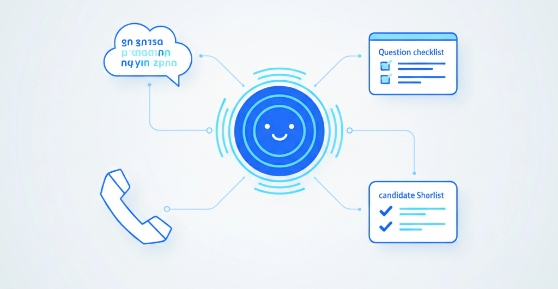
An AI recruiter voice agent is AI software that phones candidates, holds natural spoken screening conversations, asks role-specific qualification questions, handles follow-ups and records structured answers so recruiters can shortlist faster. It automates repetitive first-round calling while recruiters keep control of hiring decisions.
Key takeaways
- Voice agents conduct spoken, two-way first-round screening calls.
- Recruiters configure questions and review the resulting answers and suggested shortlist.
- Language support, consent and a path to a person matter for candidate experience.
- Human recruiters remain responsible for consequential and final hiring decisions.
An AI recruiter voice agent speaks with applicants by phone to gather answers relevant to a particular opening. It can ask configured core questions, seek clarification and organise the conversation for a recruiter to review. Candidates still need a clear way to speak to a person.
Voice agent vs IVR / chatbot
An interactive voice response (IVR) system usually routes callers through fixed menus. A text chatbot exchanges written messages. A voice agent instead conducts a two-way spoken screening conversation and can ask a relevant follow-up when an answer needs clarification.
Voice agent vs human recruiter calls
A voice agent complements, rather than replaces, recruiter calls. It can gather repeatable first-round information across an applicant pool; a recruiter is better placed to build rapport, discuss sensitive circumstances, assess nuanced experience and decide who moves forward.
Why Recruiters Are Using Voice Agents
First-round phone screens are valuable, but coordinating them across many applicants can consume time that recruiters need for deeper conversations. Common challenges include:
- Repetitive calling for every opening.
- Unanswered calls and the need to arrange callbacks.
- Slow first contact after an application arrives.
- Screening questions that vary between callers.
- Language diversity across Indian states.
- Limited recruiter bandwidth during mass hiring drives.
How an AI Recruiter Voice Agent Works, Step by Step
The exact workflow depends on the platform and the hiring team's configuration. A typical recruiter-led process looks like this:
Import candidates
Bring applicants into the screening workflow from an ATS, job portal or spreadsheet. These channels supply candidates; the voice agent screens them rather than sourcing new applicants.
Configure the role and questions
Set role-relevant questions and criteria, such as location, shift availability, notice period, expected salary, experience and language comfort. Identify which answers need recruiter review.
Call at suitable times
Arrange calling windows and, where supported, use a language the candidate prefers. The agent should identify itself as AI and explain the purpose of the call.
Hold a qualification conversation
Ask the core questions and follow up on unclear or incomplete answers instead of treating every response as a fixed menu choice.
Handle missed calls and callbacks
Use configured retries, follow-ups or rescheduling when a candidate cannot answer or cannot complete the conversation at that time.
Organise answers for evaluation
Prepare a transcript and summary and evaluate responses against recruiter-set criteria. Suggested scores or a shortlist are inputs to review, not hiring decisions.
Let recruiters choose the next step
A recruiter checks the underlying answers, follows up where needed and decides whether to arrange an AI video interview, an in-person round or another appropriate step.
An illustrative Pune staffing workflow
A staffing firm screening warehouse associates in Pune could ask about shift availability, travel distance and a two-wheeler licence in Hindi or another supported language. Recruiters would review the answers and suggested shortlist before deciding whom to contact next. Language availability should be confirmed for the specific deployment.
Key Benefits for Recruiting Teams
Less manual calling effort
Gather repeatable first-round answers without asking a recruiter to conduct every initial call.
Better candidate outreach
Contact more applicants through a configured workflow and follow up on missed calls where retries are supported.
Faster initial screening
Begin a configured phone screen sooner after an applicant enters the workflow.
Support for high-volume drives
Organise initial conversations across larger applicant pools during seasonal or location-based hiring.
Multilingual conversations
Offer supported languages that make spoken screening more accessible to candidates across regions.
Consistent core questions
Use the same role-relevant starting questions while allowing clarification when an answer calls for it.
Documented answers
Give reviewers transcripts and summaries they can consult instead of relying only on call notes.
More time for people
Help recruiters focus on candidate relationships, nuanced assessment and decisions that require human judgement.
Essential Features to Evaluate
Ask vendors to demonstrate these capabilities against a real role and the languages your applicants use:
- Natural two-way conversation and interruption handling.
- Multilingual and mixed-language support, including Hinglish where needed.
- A role-specific question builder with configurable knockout questions.
- Relevant follow-up questions for incomplete answers.
- Call scheduling, retries and callback handling.
- Transcripts, appropriately retained recordings and summaries.
- Configurable scoring and suggested automated shortlisting.
- ATS or job-portal integration for candidate intake and record updates.
- Escalation to a human recruiter.
- Consent, opt-out, data-privacy and security controls.
- Analytics dashboards for reviewing the screening workflow.
- An option to continue to AI video interviews where appropriate.
Manual Recruiter Calling vs an AI Recruiter Voice Agent
Both approaches have a place. A voice agent can support repeatable initial screening; people remain essential for relationships, context and consequential decisions.
| Consideration | AI recruiter voice agent | Manual recruiter calling |
|---|---|---|
| Calling capacity | Runs initial screens through a configured calling workflow. | Depends on the team's available calling time. |
| Availability and hours | Can use configured calling windows and callbacks. | Requires a suitable time for both recruiter and candidate. |
| First contact speed | Can start outreach when an applicant enters the workflow. | Starts when a recruiter is available to call. |
| Question consistency | Uses configured core questions and criteria. | Can adapt freely, though core questions may vary by caller. |
| Language coverage | Depends on tested support for the required languages and accents. | Depends on the languages spoken by available recruiters. |
| Follow-ups and retries | Can use configured clarification, retries and callbacks. | Allows highly contextual follow-up, subject to team capacity. |
| Documentation | Can organise transcripts and summaries for review. | Depends on the recruiter's notes and recording practices. |
| Recruiter time | Collects repeatable answers for subsequent human review. | Requires a recruiter to conduct each conversation. |
| Rapport and persuasion | Offers a conversational first contact but cannot replace a relationship. | Better for trust-building, persuasion and sensitive discussion. |
| Complex or senior-role judgement | Can collect initial information for a reviewer. | Better suited to nuance, leadership assessment and judgement. |
| Best for | Repeatable first-round screens across larger applicant pools. | Deeper assessment, relationships and hiring decisions. |
Hear how a recruiter-led voice screen works
Explore an AI recruitment call or book a demo to discuss the roles, languages and review process your team needs.
AI Recruiter Voice Agent Use Cases
IT hiring
Gather notice period, current CTC, tech stack and location preferences before a recruiter arranges technical rounds.
Explore ATS-connected interviewingBFSI hiring
Structure initial conversations for frontline sales or collections roles and route candidate answers to the hiring team for review.
Read the BFSI hiring guideRead the multilingual NBFC storyRetail hiring
Ask store applicants about location, shift availability and customer-facing experience during seasonal or multi-location hiring.
Read the retail hiring guideRead the V2 Mart storyManufacturing hiring
Collect shift, location and relevant experience details for distributed or blue-collar workforce openings.
Explore manufacturing workflowsBPO and call centers
Discuss language comfort, communication, availability and role expectations in a spoken first-round screen.
Learn about AI audio interviewsFrontline and logistics hiring
Gather availability, location and role-specific eligibility details before local recruiters review applicants.
Read the logistics hiring guideExplore high-volume interviewingStaffing agencies
Configure distinct first-round questions for multiple client requisitions, then let consultants review answers before submitting candidates.
Read the agency calling guideRead the Milestone Career storyLimitations and Responsibilities
Automated candidate screening should produce reviewable evidence, not substitute for a fair, human-led hiring process.
- Do not use a voice agent to make final hiring decisions or as the sole assessment for senior or leadership roles.
- The usefulness of its evaluation depends on well-designed questions and job-relevant criteria.
- Noise, poor connectivity and some dialects can affect speech recognition; test with representative candidates.
- Some applicants prefer a human conversation. Explain the process, offer an opt-out and provide a path to a recruiter.
- Monitor outcomes for unfair patterns and let people review or correct errors.
- For deployment in India, assess applicable notice and consent obligations under the Digital Personal Data Protection Act, 2023, and TRAI rules for commercial communications. Consult qualified legal counsel.
Best Practices for a Recruiter-Led Rollout
Pilot one high-volume role
Choose an opening with repeatable first-round questions and review the candidate and recruiter experience before expanding.
Keep calls short
Ask only what is needed to determine the appropriate next step.
Disclose the AI caller
Identify the caller as AI at the start and explain why the candidate is being contacted.
Set clear knockout criteria
Define job-relevant requirements and flag uncertain answers for a person rather than treating them as automatic rejections.
Use the candidate's language
Write and test questions in the languages candidates prefer, including common mixed-language responses where relevant.
Calibrate regularly
Review transcripts weekly during a pilot and adjust questions and suggested scoring against recruiter judgement.
Provide human escalation
Give candidates a clear route to a recruiter for questions, corrections or an alternative screening format.
Connect the workflow
Integrate with the ATS where available so reviewers can find answers alongside existing candidate records.
Measure your own baseline
Compare candidate experience, review quality and team effort with your existing process rather than assuming a universal result.
How Mishuk Labs Fits
Mishuk Labs offers voice-based candidate screening: its AI calls candidates, asks role-specific questions and follows up on answers in Hindi, English and other supported Indian languages. It also offers automated candidate evaluation, suggested shortlisting and AI video interviews with proctoring signals for review.
Recruiters set the criteria, review candidate responses and make final decisions. Candidates come from the team's existing channels; the screening workflow does not source them.
Explore AI recruitment calling softwareLearn about multilingual voice recruitingRead the AI hiring platform guideRead customer storiesConclusion
An AI recruiter voice agent can help teams organise repeatable first-round calls and give recruiters structured answers to review. The strongest fit is a clearly scoped screening workflow with tested language support, candidate choice and human oversight—not automated final decisions.