
The short answer
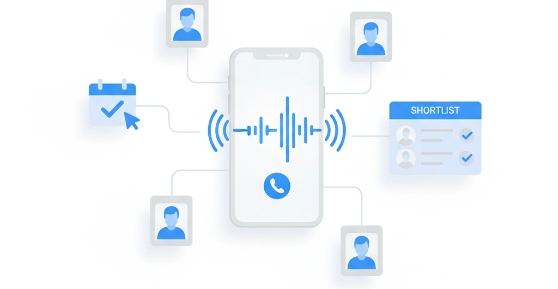
AI recruitment calling software uses an AI voice agent to phone candidates automatically, run role-specific screening conversations, ask follow-up questions, schedule callbacks, and score and shortlist applicants. Recruiters can then spend more time reviewing potentially qualified candidates instead of conducting every repetitive first-round call. The hiring team defines the criteria and remains responsible for decisions about who moves forward.
AI recruitment calling software conducts initial candidate conversations over the phone. A hiring team configures the role, questions and evaluation criteria; an AI voice agent contacts applicants, listens to their answers, asks relevant follow-ups and organises the results for recruiter review.
It is a form of recruitment automation software focused on spoken outreach and screening. Its usefulness depends on the call experience, the quality of the questions, and how carefully recruiters review the resulting transcripts and evaluations.
How it differs from IVR, auto-dialers and chatbots
An IVR guides callers through fixed menus. An auto-dialer helps place calls but does not itself conduct an interview. A chatbot collects written replies. AI recruitment calling instead uses a spoken, role-specific conversation that can respond to what a candidate says and ask a relevant follow-up.
How AI Recruitment Calling Works
- Import or receive candidates from job portals, an applicant tracking system (ATS) or spreadsheets.
- Configure the role and screening questions covering eligibility, location, experience, salary expectations, availability and language.
- Call candidates in a supported language they prefer to speak.
- Conduct a role-specific conversation and ask relevant follow-up questions.
- Arrange retries or callbacks when a candidate misses the call or is busy.
- Transcribe responses and evaluate them against criteria set by the hiring team.
- Send a suggested shortlist to recruiters or the ATS for human review and the next round.
An illustrative retail hiring workflow
A retail chain hiring store staff across cities could have the AI call applicants to confirm their location, shift availability, preferred language and prior retail experience. Recruiters would then review the responses and suggested shortlist before deciding whom to interview.
Benefits for Hiring Teams
Faster candidate outreach
Begin configured screening calls after applications arrive instead of waiting for a recruiter to work through a calling list.
Consistent screening
Ask candidates the same core role-relevant questions while allowing follow-ups that clarify their answers.
More time for recruiters
Move repeatable first-round questions out of recruiters’ schedules so they can focus on review and deeper conversations.
Support for hiring peaks
Organise initial outreach when high-volume or seasonal hiring creates more applicants than a team can readily call by hand.
Multilingual reach
Where supported, speak with candidates in a language they are comfortable using and retain their answers for review.
More convenient callbacks
Offer another time when a candidate is busy rather than treating a missed call as a completed screen.
Reviewable records
Keep transcripts and, where appropriately recorded, call audio so recruiters can revisit answers and review evaluations.
Essential Features to Look For
- Natural AI voice calls
- Multilingual and mixed-language support, including Hinglish where needed
- A role-specific question builder
- Relevant follow-ups and interruption handling
- Retries and callback scheduling
- Transcripts and recordings
- Configurable scoring and suggested shortlisting
- ATS and job-portal integrations
- An analytics dashboard
- Consent, opt-out and data-security controls
- A clear path to human handoff
Limitations to Consider
- Initial AI calls are not a substitute for nuanced senior-role assessment or complex hiring judgement.
- Poor connectivity, background noise and spam-labelling of unfamiliar numbers can affect whether a call connects and how well it is understood.
- Some candidates prefer speaking with a person; provide a clear way to reach one.
- Unclear or poorly designed questions can produce incomplete or irrelevant responses.
- Recruiters should review scores and monitor the process for unfair or biased outcomes.
- In India, assess applicable notice and consent obligations under the Digital Personal Data Protection Act, 2023, and telecom rules for commercial communications, including TRAI requirements. Consult qualified legal counsel before deployment.
Use Cases by Industry
Retail
Discuss store location, shifts, availability and customer-facing experience before a recruiter follows up.
Retail hiring guideV2 Mart customer storyBFSI and NBFC
Ask frontline sales applicants about relevant experience, location and role requirements.
BFSI hiring guideNBFC customer storyManufacturing
Organise initial conversations for distributed workforce roles and route responses to local hiring teams.
Manufacturing workforce guideBPO and customer support
Use a spoken first-round conversation to discuss communication, language preferences and availability.
Staffing agencies
Gather role-specific answers before consultants review candidates and speak with clients.
Agency calling guideMilestone Career customer storyFrontline and logistics
Discuss location, shift requirements and relevant experience across distributed applicant pools.
High-volume recruitment guideLogistics hiring guideAI Recruitment Calling vs Manual Recruitment Calling
AI calling can take on configured first-round conversations. Recruiter-led calls remain important for relationships, sensitive follow-up and complex decisions.
| Consideration | AI recruitment calling | Manual recruitment calling |
|---|---|---|
| Outreach speed | Can start configured calls when candidates enter a workflow. | Depends on when a recruiter can work through the calling list. |
| Availability and hours | Can offer calls and callbacks within configured calling windows. | Depends on recruiter and candidate schedules. |
| Consistency | Uses configured role questions and evaluation criteria. | Can adapt freely, though questions may vary by interviewer. |
| Capacity | Supports multiple initial conversations through an automated workflow. | Depends on the hiring team’s available calling time. |
| Recruiter time | Organises repeatable initial answers for later review. | Requires a recruiter to conduct each conversation. |
| Language coverage | Depends on demonstrated support for the required languages and accents. | Depends on the languages spoken by available recruiters. |
| Follow-ups | Can ask follow-ups within the configured role and conversation. | Can pursue unexpected or sensitive answers with greater flexibility. |
| Documentation | Can provide transcripts, recordings and structured summaries. | Depends on recruiter notes and the team’s recording process. |
| Empathy and relationships | Offers a conversational first contact; some candidates prefer a person. | Allows direct human rapport and relationship-building. |
| Complex judgement | Provides information against configured criteria for human review. | Better suited to nuance, context and sensitive decisions. |
| Best for | Repeatable first-round screening across larger applicant pools. | Deeper interviews, relationship-building and hiring decisions. |
Hear an AI recruitment call
Explore a voice sample or book a demo to discuss candidate screening for your roles.
How Mishuk Labs Approaches AI Recruitment Calling
Mishuk Labs is an AI recruitment calling and candidate screening platform. Its AI voice recruiter calls candidates, conducts role-specific screening in Hindi, English and other supported Indian languages, and follows up on answers. It scores and suggests shortlists for recruiters to review.
AI video interviews are also available when a later round calls for a visual conversation. Recruiters remain responsible for reviewing candidates and making final hiring decisions.
Learn about multilingual voice recruitingExplore AI audio interviewsRead customer storiesHow to Choose AI Recruitment Calling Software
Ask vendors to demonstrate a realistic conversation for one of your roles, then examine how the results reach your recruiting team.
Languages
Does the agent handle the languages, accents and mixed-language speech your candidates actually use?
Customisation
Can your team control questions, follow-ups, eligibility rules and evaluation criteria?
Integrations
How do candidates enter the workflow, and how do transcripts and suggested shortlists return to your ATS?
Privacy and storage
Where are recordings and transcripts stored, who can access them, and how are consent, retention and deletion handled?
Pilot
Can you test call quality and recruiter review with a representative role before expanding the workflow?
Frequently Asked Questions
Sources
About Mishuk Labs
Mishuk Labs is an AI recruitment technology platform operated by Hireonix Apexinfo Private Limited. Its products include AI Phone Calling for candidate screening, AI Video Interviews and AI Voice Exit Interviews.
Founded by Pintu Shaw, Mishuk Labs works with employers and recruitment agencies across India.