
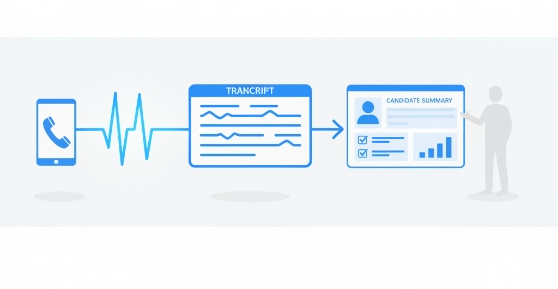
AI voice analysis in recruitment is the use of speech recognition and language AI to turn a candidate's spoken screening answers into transcripts, structured summaries and job-related scores, so recruiters can shortlist faster. It is used by recruiters, talent acquisition teams and staffing agencies — especially in high-volume hiring for BFSI, BPO, retail, logistics and sales roles — and it analyses what candidates say, not who they are.
Scope: this article covers content-based analysis — what candidates say in answer to job-related questions. It does not cover, and Mishuk Labs does not use, inference of personality, emotion, honesty or other traits from how a voice sounds. Acoustic features are used only to transcribe speech and, where a role genuinely requires it and candidates are told, to support a disclosed language-fluency check.
Key takeaways
- Converts spoken screening answers into transcripts, summaries and job-related scores.
- Built for recruiters, TA teams and staffing agencies handling high-volume hiring.
- Should evaluate answer content — not accent, tone or personality traits.
- Recruiters stay in control of every shortlisting decision.
Recruiters, agency founders and staffing teams often need to speak with more applicants than they can reach promptly. AI voice analysis in recruitment can make the first conversation easier to organise, provided the evaluation stays grounded in the candidate’s answers and the requirements of the role.
What is AI voice analysis in recruitment?
AI voice analysis in recruitment is the use of AI to conduct candidate phone conversations, transcribe and understand spoken answers, ask contextual follow-up questions and organise responses into structured summaries that recruiters review against job-related criteria. Responsible use focuses on what candidates say — not on inferring personality or emotion from their voice.
How AI Voice Analysis Works
The useful output is a reviewable record of a conversation, not an automatic hiring decision. A typical first-screen workflow follows these steps:
Define the role
The recruiter sets job-related questions and evaluation criteria, such as required experience, shift availability and location.
Contact the candidate
The AI calls within an appropriate contact window, explains its purpose and provides the required notice and choice before proceeding. [DPDP Act 2023] [TRAI TCCCPR]
Transcribe spoken answers
Speech recognition converts replies into text. Teams hiring across India should test relevant languages, regional accents and mixed-language answers such as Hinglish. Accuracy varies by accent and speaker group. [Svarah 2023] [IndicVoices 2024] [Koenecke et al. 2020]
Interpret the content
Language understanding identifies information the candidate actually shared: experience, availability, location, salary expectations and role-specific skills.
Clarify and organise
If an answer is vague, the agent can ask a contextual follow-up. It then prepares a structured summary and maps responses to the approved criteria.
Hand off to a recruiter
A person reviews the answers, resolves uncertainty and decides next steps. Approved information may sync to an applicant tracking system (ATS).
What Voice Analysis Should — and Shouldn't — Do
Voice analysis in recruitment can mean two very different things. Content-based analysis examines what an applicant says about the job. Vocal-trait inference claims to read attributes from how their voice sounds. Those claims should not be confused.
| Question | Content-based analysis (job-related) | Vocal-trait inference (unreliable) |
|---|---|---|
| Evidence | Reviews stated experience, qualifications and availability against defined requirements. | Attempts to infer personality, honesty or confidence from pitch, tone or pace. |
| Follow-up | Asks the candidate to clarify an incomplete or ambiguous answer. | Treats a vocal pattern as an answer the candidate never gave. |
| Review | Preserves responses and criteria for a recruiter to inspect and correct. | Reduces a person to an opaque voice score or presumed emotional state. |
Voice characteristics alone cannot reliably establish personality, honesty, emotion, confidence or job suitability. Accents, speech differences, disabilities and noisy phone lines make such inferences especially concerning for accuracy and fairness. Evaluate what candidates say against transparent, job-related criteria instead. Language fluency or clarity may be assessed when genuinely required for a role, such as a BPO voice process, and candidates should be told about that assessment. [Barrett et al. 2019] [Koenecke et al. 2020] [Svarah 2023]
The NIST AI Risk Management Framework is a voluntary framework (not law) that can help teams examine job-relatedness, transparency and potential harms. India-specific legal duties are covered below. [NIST AI RMF]
Evidence from a deployment: transcription quality in an NBFC screen
Customer and internal review figures from one deployment, not a benchmarkAn anonymous Bengaluru-based Indian NBFC with 150 branches used Mishuk Labs AI Phone Calling for Field Sales Officer hiring across seven states from 17–30 August 2026. The NBFC's recruiters assigned each candidate one of seven languages: Hindi, English, Marathi, Telugu, Tamil, Kannada or Odia. Of 6,500 unique candidates called, 6,200 answered (95.4%), 5,800 completed the full AI screening (93.5% of answered), and 400 were shortlisted by the NBFC's recruiters from 400 AI suggestions. Final hires were not reported. The NBFC approved these figures for publication; they were not independently audited.
| Metric | Value | How measured |
|---|---|---|
| Full screening completion | 5,800 | 93.5% of 6,200 candidates who answered; NBFC-approved figures, not independently audited |
| Languages | 7 | Hindi, English, Marathi, Telugu, Tamil, Kannada and Odia; assigned per candidate by the NBFC's recruiters |
| Transcription accuracy | ~90% | Recruiter review of sampled transcripts against recordings, 7–14 October 2026 |
| Word error rate (WER) | ~3% | Word-level comparison of sampled transcripts with recordings, 7–14 October 2026 |
| What was analysed | Answer content only | Experience, location, availability and role answers; no vocal-trait scores |
How the figures were checked: during 7–14 October 2026, sampled call recordings were compared with their transcripts. Word error rate counts substituted, missing and inserted words as a share of words spoken; the accuracy figure reflects recruiters' judgement of whether a transcript correctly captured the answer. The two measures use different methods and should not be read as one number.
Limitations
- One customer, one week of checks and a sample of calls; results will vary by language, accent, line quality and role.
- Figures are customer- or internally reported and not independently audited.
- Sample size and per-language breakdown are not published here.
- A low word error rate does not guarantee a correct interpretation; recruiters still checked recordings for consequential answers.
Benefits of AI Voice Analysis in Recruitment
The value of AI voice screening depends on the role, call experience and quality of recruiter review. Practical reasons to consider it include:
Less repetitive calling
An agent can gather routine first-round answers while recruiters spend more time on clarification, relationships and decisions.
Consistent first screens
Approved questions give applicants a comparable starting point, while follow-ups can address what each person actually says.
Earlier engagement
A configured conversation can begin soon after an application, subject to consent, contact preferences and suitable calling hours.
Support during hiring peaks
Repeatable screens can help organise applications during festive retail hiring, BPO ramps or new branch launches.
Multilingual reach
Candidates may explain their experience more comfortably in a supported language. Test real accents and code-switching before rollout. [NBFC case study]
Organised review
Transcripts and structured summaries make it easier to revisit an answer than relying on hurried notes alone. [NBFC case study]
AI Voice Screening vs Traditional Phone Screening
AI candidate screening can structure a repeatable first conversation. A recruiter-led call remains important when context, trust or negotiation matters.
| Factor | Traditional | AI voice screening |
|---|---|---|
| Availability | Depends on a recruiter and candidate finding a shared time. | Can offer configured contact windows and callbacks. |
| Consistency | Question wording may differ between interviewers. | Can begin with approved role-specific questions. |
| Scale | Each additional call requires interviewer time. | Can organise repeatable first screens across hiring queues. |
| Note-taking | A recruiter records key points during or after the call. | Can prepare a transcript and summary for verification. |
| Languages | Depends on languages spoken by available staff. | Depends on configured, tested language coverage. |
| Judgement and rapport | A person can explore nuance and build a relationship directly. | Needs human review and a clear route to a person. |
| Recruiter time | Includes introductions and recurring first questions. | Shifts some effort toward reviewing evidence and exceptions. |
When a human call is better
When is a human call better? Use one for senior or sensitive conversations, accommodations, complex circumstances and compensation negotiation. Candidates should also be able to reach a person when an automated screen is unsuitable.
Hear a candidate screening conversation
Explore how spoken, job-related answers become a record recruiters can review.
AI Voice Screening Use Cases
Choose questions that reflect the actual role. These examples describe first-round information gathering, not automated suitability decisions.
IT hiring
Gather project experience, technical context and availability before a specialist interview.
Enterprise interviews and ATS workflowsBFSI
Ask branch or field-sales applicants about territory, relevant experience and location preferences.
BFSI voice recruitmentRetail
Clarify store preference, shift availability and customer-facing experience during seasonal hiring.
Retail hiring workflowsManufacturing
Collect site, shift and stated certification details for subsequent human verification.
Manufacturing workforce guideBPO and call centres
Discuss process requirements. Assess spoken language only where fluency or clarity is genuinely required and disclosed to candidates.
AI audio interviewsFrontline and logistics
Confirm service area, work schedule and role experience through a phone conversation.
Logistics and frontline hiringRecruitment agencies
Keep each client’s criteria distinct while coordinating initial screens across vacancies.
Agency calling guideKey Features to Evaluate
Compare AI recruitment technology using a real role and representative candidate calls, not a feature list alone.
- Role-specific questions tied to documented requirements.
- Contextual follow-ups when an answer needs clarification.
- Multilingual conversations tested with relevant accents and mixed-language speech. Explore multilingual screening
- Accessible transcripts and candidate summaries that preserve the original answer.
- Transparent evaluation criteria, without black-box vocal-trait scores.
- Reporting that helps teams inspect completion and review outcomes.
- ATS integration with clear field mapping and failure handling. Explore ATS integration
- Recruiter override and an easy handoff to a person.
- Consent, access, deletion and retention controls.
Legal duties vs voluntary practice (India)
This separates what Indian law requires from practices we recommend. It is operational guidance, not legal advice; consult qualified counsel.
Legal duties (India)
Notice to candidates
Under the DPDP Act, 2023, a notice must describe the personal data and the purpose of processing (Section 5). [DPDP Act 2023] [DPDP Act (MeitY)]
Valid consent where consent is the basis
Consent must be free, specific, informed, unconditional and unambiguous, and can be withdrawn (Section 6). [DPDP Act 2023]
Operational requirements under the Rules
The DPDP Rules, 2025 add phased requirements on notice content, security safeguards and retention. [DPDP Rules 2025]
Outbound calling rules
Commercial calls may fall under TRAI's TCCCPR, 2018 as amended; assess the actual calling workflow and contact preferences. [TRAI TCCCPR] [TRAI amendments]
Recommended voluntary practice
Disclose AI involvement and recording
Tell candidates an AI is calling and whether the call is recorded, even where not expressly required.
No vocal-trait scoring
Do not score emotion, honesty or personality from voice; research does not support reliable inference. [Barrett et al. 2019]
Test by accent and language
ASR error rates vary across speaker groups and accents; test with your applicant population. [Koenecke et al. 2020] [Svarah 2023] [IndicVoices 2024]
Governance framework
The NIST AI RMF is a voluntary framework that can help structure risk review; it creates no legal obligation in India. [NIST AI RMF]
Human alternative and review
Offer a human callback and keep progression decisions with recruiters.
Best Practices for Responsible Voice Analytics in Hiring
Give clear notice and obtain appropriate consent
Legal duty (India): give a DPDP Act notice and, where consent is the basis, obtain valid consent. Recommended practice: also disclose AI involvement and recording. [DPDP Act 2023] [DPDP Rules 2025]
Check outbound-calling requirements
Legal duty (India): assess applicable TRAI Telecom Commercial Communications Customer Preference Regulations (TCCCPR) for the actual calling workflow and contact preferences. [TRAI TCCCPR] [TRAI amendments]
Protect candidate data
Legal duty (India) and recommended practice: limit access to recordings and transcripts, define retention periods and delete information when it is no longer needed. [DPDP Rules 2025]
Test fairness using job-related evidence
Recommended practice: test across accents, languages, speech differences and call conditions. Audit outcomes, correct transcription errors and avoid scoring presumed vocal traits. [Koenecke et al. 2020] [Svarah 2023]
Provide an accessible alternative
Recommended practice: offer a human callback or another suitable channel for candidates who cannot or do not wish to complete a voice screen.
Keep people accountable
Recommended practice: recruiters should inspect uncertain answers and make progression decisions. This operational guidance is not legal advice; consult qualified counsel.
Where Mishuk Labs Fits
Mishuk Labs provides voice-based candidate screening with role-specific questions and contextual follow-ups. It supports conversations in 14+ Indian regional languages, including Hinglish. In one NBFC deployment, sampled transcripts were checked at about 90% accuracy and a 3% word error rate (7–14 October 2026). [NBFC case study]
Candidate evaluations organise job-related responses for recruiter review. Recruiters can inspect the evidence, resolve uncertainty and make final decisions; the conversation is not a substitute for their judgement.
Conclusion
AI voice analysis in recruitment is most useful when it makes a first conversation accessible, captures relevant answers and gives recruiters a clearer record to review. Define the job criteria first, test the experience with real candidates, protect their information and keep a human route open. Assess the content of answers—not imagined traits in a voice.
Frequently Asked Questions
Sources
- Digital Personal Data Protection Act, 2023 (Section 5 'Notice', Section 6 'Consent') — India CodeLaw (India)Legal duty
- Digital Personal Data Protection Act, 2023 — MeitYLaw (India)Legal duty
- Digital Personal Data Protection Rules, 2025 (notified 13 Nov 2025, phased commencement) — MeitYLaw (India)Legal duty
- TRAI Telecom Commercial Communications Customer Preference Regulations, 2018 (consolidated, as amended)Regulation (India)Legal duty
- TRAI TCCCPR amendments index (incl. Second Amendment, 12 Feb 2025)Regulation (India)Legal duty
- NIST AI Risk Management Framework 1.0 (voluntary)Voluntary guidanceVoluntary practice
- Barrett et al. (2019), Emotional Expressions Reconsidered — Psychological Science in the Public InterestResearchEvidence
- Koenecke et al. (2020), Racial disparities in automated speech recognition — PNASResearchEvidence
- Javed et al. (2023), Svarah: Evaluating English ASR on Indian accents — InterspeechResearchEvidence
- IndicVoices (Findings of ACL 2024)ResearchEvidence
About Mishuk Labs
Mishuk Labs is an AI recruitment technology platform operated by Hireonix Apexinfo Private Limited. Its products include AI Phone Calling for candidate screening, AI Video Interviews and AI Voice Exit Interviews.
Founded by Pintu Shaw, Mishuk Labs works with employers and recruitment agencies across India.