
Who Is the Customer?
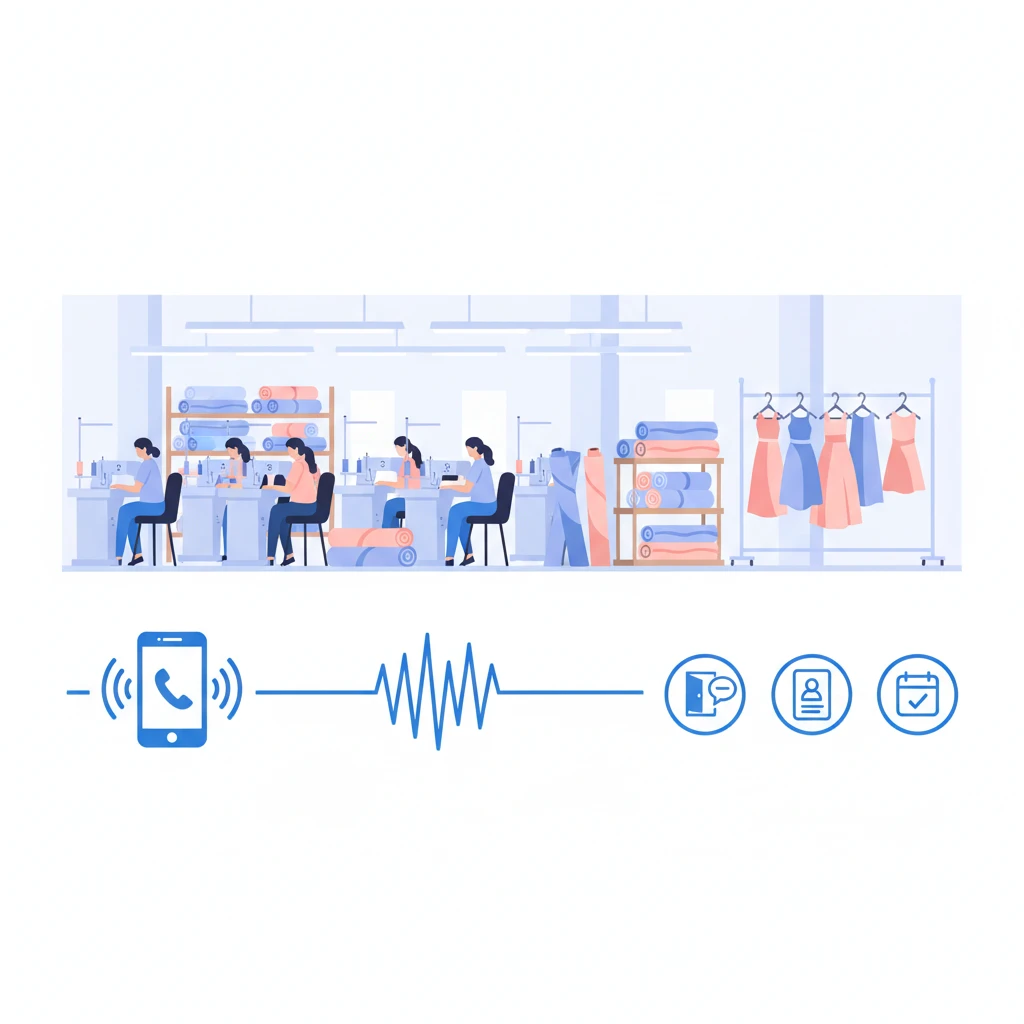
The customer is an Indian garment manufacturing and export company, established in 1973, with 20,000 employees across 12 factories in North India; its name is withheld at its request.
| Customer | Indian garment manufacturing and export company — name withheld |
|---|---|
| Established | 1973 |
| Workforce | 20,000 employees |
| Factories | 12 factories in North India |
| Products | Women's wear and kids' wear |
| Export markets | Brands in the UK, Germany, France, Spain, Sweden, Norway and Denmark |
| Campaign period | 17–25 August 2026 |
| Language | Hindi only, chosen by the customer |
| Data basis | Counts reported by the customer; percentages calculated by Mishuk Labs; not independently audited |
All profile facts were supplied by the customer for this story. The customer approved anonymous publication in writing.
Which HR Workflows Did the Customer Move to AI Calling?
The customer used AI calling in Hindi for three workflows that otherwise need HR staff to phone people one by one: exit interviews, first-round recruitment screening and absence follow-up.
A manufacturer with 20,000 employees across 12 factories has to speak to large numbers of departing employees, job candidates and absent employees. Each of these conversations is a phone call that an HR or recruitment team member would otherwise make individually.
In this campaign the customer used Mishuk Labs AI calling for three workflows: AI exit interviews with employees serving notice, AI recruitment calling for Sales Development Manager candidates, and AI absenteeism calling with employees about their absence. All calls were made in Hindi.
The customer reported that absence tracking was previously manual. Other operational challenges were not reported and are not described in this story.
How Did the Customer Use AI Exit Interviews in Hindi?
Mishuk Labs AI exit interviews called 100 employees who had resigned and were serving notice; 80 connected (80%) and 70 completed the interview (87.5% of those connected). Of the 70, 20 later withdrew their resignation after HR retention discussions.
The 100 employees called had resigned and were serving their notice period. Each employee was called once, in Hindi, with no retry calls.
Of the 100 employees called, 80 connected and 70 completed the AI exit interview. The 10 employees who connected but did not complete are not counted as refusals; their reasons were not reported.
| Metric | Count or share | Calculation | Basis |
|---|---|---|---|
| Employees called | 100 | — | Customer-reported |
| Connected | 80 | 80 ÷ 100 = 80% connection rate | Customer-reported count; rate calculated by Mishuk Labs |
| Completed | 70 | 70 ÷ 80 = 87.5% completion rate among connected | Customer-reported count; rate calculated by Mishuk Labs |
| Reason: shift timing | 14 of 70 (20%) | 14 ÷ 70 = 20% | Customer-reported; base: 70 completed exit interviews |
| Reason: poor workplace conditions | 8 of 70 (11.4%) | 8 ÷ 70 = 11.4% (customer reported about 12%) | Customer-reported; base: 70 completed exit interviews |
| Withdrew resignation after HR discussion | 20 of 70 | 20 ÷ 70 = 28.6% | Customer-reported count; rate calculated by Mishuk Labs |
The customer reported shift timing and poor workplace conditions as the two major exit reasons among the 70 employees who completed an AI exit interview, with one reason recorded per employee; the remaining employees gave other or various reasons that were not itemised.
What happened after the exit interviews?
The AI exit interviews recorded each employee's actual reason for leaving. The customer's HR team used these reasons to hold retention discussions with employees serving notice, and 20 of the 70 employees who completed an exit interview withdrew their resignation (28.6%, calculated by Mishuk Labs). HR facilitated the discussions and made every retention decision; the AI did not decide who was retained.
How Did AI Recruitment Calling Screen Sales Development Manager Candidates?
Mishuk Labs AI recruitment calling called 1,000 Sales Development Manager candidates in Hindi; 910 picked up (91%), 800 completed screening (87.9% of pickups) and the customer's HR team moved 200 to the next interview round (25% of completed screenings).
The customer used AI recruitment calling to run first-round Hindi screening for the Sales Development Manager role. Each candidate was called once, with no retry calls.
Of 1,000 candidates called, 910 picked up and 800 completed the screening call. The customer's HR and recruitment team reviewed the AI screening results and moved 200 candidates to the next interview round.
| Metric | Count | Calculation | Basis |
|---|---|---|---|
| Candidates called | 1,000 | — | Customer-reported |
| Picked up | 910 | 910 ÷ 1,000 = 91% pickup rate | Customer-reported count; rate calculated by Mishuk Labs |
| Completed screening | 800 | 800 ÷ 910 = 87.9% completion rate among pickups | Customer-reported count; rate calculated by Mishuk Labs |
| Moved to next interview round | 200 | 200 ÷ 800 = 25% next-round progression among completed screenings | Customer-reported; chosen by the customer's HR team |
Final hiring outcomes after the next interview round were not reported, so this story does not state how many candidates were hired or joined.
Explore Hindi AI calling for manufacturing HR
Structured AI calls for exit interviews, recruitment screening and absence follow-up, with recordings, transcripts and reports for HR review.
How Did AI Calling Support Absenteeism Management?
Mishuk Labs AI absenteeism calling called 250 employees about their absence in Hindi; 220 connected (88%), 150 gave a reason for absence (68.2% of connected) and 140 completed the call (93.3% of those who gave a reason).
The customer used AI calling to contact employees about their absence and record the reason in Hindi. Each employee was called once, with no retry calls.
In this story, connected means the employee answered the call; gave a reason means the employee stated a reason for the absence; and completed means the employee answered every question in the call. Each stage is a subset of the stage before it, as confirmed by the customer.
| Metric | Count or share | Calculation | Basis |
|---|---|---|---|
| Employees called | 250 | — | Customer-reported |
| Connected | 220 | 220 ÷ 250 = 88% connection rate | Customer-reported count; rate calculated by Mishuk Labs |
| Gave a reason for absence | 150 | 150 ÷ 220 = 68.2% of connected | Customer-reported count; rate calculated by Mishuk Labs |
| Completed the call | 140 | 140 ÷ 150 = 93.3% of those who gave a reason | Customer-reported count; rate calculated by Mishuk Labs |
| Reason: not feeling well | 84 of 140 (60%) | 60% of 140 = 84 | Customer-reported share; base: 140 completed calls |
The customer reported not feeling well as the major reason for absence: 84 of the 140 employees who completed the call (60%). Other reasons were not itemised. This story does not claim that absenteeism fell.
Results at a Glance
The table below lists every customer-reported count and every Mishuk Labs calculation for the three use cases, with each denominator named.
| Use case | Called | Connected / picked up | Completed | Next step reported | Key calculated rate |
|---|---|---|---|---|---|
| AI exit interviews | 100 employees serving notice | 80 connected | 70 | 20 of 70 completers withdrew resignation after HR discussion | 87.5% completion among connected (70 ÷ 80) |
| AI recruitment calling | 1,000 candidates | 910 picked up | 800 | 200 moved to next round by HR | 25% next-round progression (200 ÷ 800) |
| AI absenteeism calling | 250 employees | 220 connected | 140 (150 gave a reason) | Not reported | 88% connection rate (220 ÷ 250) |
Counts customer-reported; rates calculated by Mishuk Labs and rounded to one decimal place.
What Business Impact and HR Workflow Changes Did the Customer Report?
The customer estimated that the campaign saved about 26 working days of one recruiter's time across all three use cases, and reported less manual absence tracking; neither figure was measured by Mishuk Labs.
- Recruiter time (customer estimate): the customer estimated that the campaign saved about one recruiter's 26 working days (1 recruiter × 26 working days) across all three use cases combined. This is the customer's estimate, not a measured figure, and the split by use case was not reported.
- Absence tracking (customer-reported): the customer reported that AI absenteeism calling reduced manual absenteeism tracking for its HR team. No hours or before-and-after figures were reported.
- Resignations withdrawn (customer-reported): 20 of the 70 employees who completed an AI exit interview withdrew their resignation (28.6%) after HR held retention discussions based on the reasons the AI recorded. HR made every retention decision.
- Exit reasons for HR action (customer-reported): shift timing (14 of 70, 20%) and poor workplace conditions (8 of 70, 11.4%) were the major reported exit reasons.
This story does not claim reduced attrition, reduced absenteeism, lower cost or faster hiring, because those outcomes were not measured.
What Did AI Do, and What Did HR Decide?
AI placed the Hindi calls, asked the configured questions and organised answers; the customer's HR team made every selection, retention and attendance decision.
AI placed every call in Hindi, asked the customer's configured questions and organised the answers into recordings, transcripts, summaries, scores and reports. The customer's HR team chose the 200 candidates who moved to the next interview round, held the follow-up discussions with employees serving notice, and reviewed the absence call outputs. AI did not decide who was shortlisted, who was retained or how absences were treated.
AI calling for manufacturing HR is the use of an AI voice agent to hold structured phone conversations with employees and candidates and return organised answers for HR review.
Which Mishuk Labs Outputs Were Used?
The customer confirmed it used recordings, transcripts, summaries, scores, structured reports and export; other capabilities are listed separately as general product features.
Used in this campaign (customer-confirmed)
- Call recordings
- Transcripts
- Summaries
- Scores
- Structured reports and dashboards
- Export to a spreadsheet or HR system
General product capabilities (not claimed for this campaign)
- Support for 14+ Indian languages; this campaign used Hindi only
- Mid-call language switching (not used — the customer chose Hindi-only calls)
- Retry calls for unanswered calls (not used in this campaign)
Data Source, Methodology and Definitions
All counts were reported by the customer, Mishuk Labs calculated the percentages, and the figures were not independently audited.
Data source
- The participating garment manufacturing and export company reported all counts, reason shares, the retention outcome and the time-saving estimate, and shared them with Mishuk Labs for publication.
- Customer approval: the participating company approved the figures in this story for anonymous publication in writing.
- The customer identity is withheld.
Metric definitions
| Metric | Definition | Calculation |
|---|---|---|
| Connection rate (exit interviews) | Employees serving notice who answered, out of all called | 80 ÷ 100 = 80% |
| Completion rate among connected (exit interviews) | Connected employees who finished the exit interview | 70 ÷ 80 = 87.5% |
| Resignation withdrawal share | Employees who completed an AI exit interview and then withdrew their resignation | 20 ÷ 70 = 28.6% |
| Exit reason share | Employees giving a reason, out of 70 completed exit interviews | 14 ÷ 70 = 20%; 8 ÷ 70 = 11.4% |
| Pickup rate (recruitment) | Candidates who answered, out of all called | 910 ÷ 1,000 = 91% |
| Completion rate among pickups (recruitment) | Candidates who picked up and finished screening | 800 ÷ 910 = 87.9% |
| Next-round progression among completed screenings | Completed screenings HR moved to the next interview round | 200 ÷ 800 = 25% |
| Connection rate (absenteeism) | Employees who answered, out of all called | 220 ÷ 250 = 88% |
| Reason rate among connected (absenteeism) | Connected employees who gave a reason for absence | 150 ÷ 220 = 68.2% |
| Completion rate among those who gave a reason (absenteeism) | Employees who answered every question | 140 ÷ 150 = 93.3% |
| Absence reason share | Employees reporting not feeling well, out of 140 completed calls | 60% × 140 = 84 |
Percentages are rounded to one decimal place and calculated by Mishuk Labs from customer-reported counts.
Methodology
- All counts are of unique people. Each person was called once, with no retry calls, and no person appears in more than one use case (customer-confirmed).
- All calls were in Hindi, chosen by the customer.
- Exit reason shares use the 70 completed exit interviews as the base; the absence reason share uses the 140 completed absence calls as the base (customer-confirmed).
- Retained means the employee withdrew their resignation.
Limitations
- Not independently audited.
- One nine-day campaign at one company; not an industry benchmark.
- The 20 withdrawn resignations followed HR retention discussions; the effect of AI exit interviews alone was not isolated.
- The customer reported poor workplace conditions as about 12%; the 8 of 70 count gives 11.4%.
- The 26 working days saved is a customer estimate across all three use cases, not a measurement.
- Not reported, so not stated: the customer's name, factory locations beyond North India, call durations, interview or screening questions, final hiring outcomes, absenteeism or attrition rates before and after, and cost savings.
Frequently Asked Questions
These answers explain how to read the exit interview, recruitment calling and absenteeism calling results in this story.
What is AI calling for manufacturing HR?
AI calling for manufacturing HR uses an AI voice agent to hold structured phone conversations with employees and candidates, such as exit interviews, first-round recruitment screening and absence check-ins. The AI asks configured questions and returns recordings, transcripts, summaries and reports. In this garment manufacturer's campaign, HR reviewed the outputs and made every decision.
How were AI exit interviews used for employees serving notice?
The customer used Mishuk Labs AI exit interviews to call 100 employees who had resigned and were serving notice. Calls were in Hindi with no retries; 80 connected and 70 completed. Of the 70 who completed, 14 cited shift timing (20%) and 8 cited poor workplace conditions (11.4%, which the customer reported as about 12%).
How did AI exit interviews help HR retain employees serving notice?
The AI exit interviews recorded each employee's actual reason for leaving. The customer's HR team used these reasons to hold retention discussions, and 20 of the 70 employees who completed an exit interview withdrew their resignation (28.6%). HR facilitated the discussions and made every retention decision; the AI did not decide who was retained.
What do pickup rate, connection rate and completion rate mean in this story?
Pickup rate and connection rate both mean people who answered the call, divided by everyone called: 91% (910 of 1,000) for recruitment, 80% (80 of 100) for exit interviews and 88% (220 of 250) for absence calls. Completion rate divides people who finished the call by people who answered, so the denominators differ.
Why does the recruitment result stop at the next interview round?
The customer reported results up to the next interview round only: its HR team moved 200 of the 800 candidates who completed AI recruitment screening (25%) to the next round. Final hiring or joining figures were not reported, so this story does not state how many Sales Development Managers were hired.
What is AI absenteeism calling?
AI absenteeism calling is an AI phone call to an absent employee that records the reason for the absence for HR. In this campaign, 250 employees were called in Hindi, 220 connected, 150 gave a reason and 140 completed the call. Of the 140 who completed, 84 (60%) reported not feeling well as the reason.
Did AI calling reduce absenteeism or attrition at this manufacturer?
This story makes no such claim. The customer reported less manual absenteeism tracking and time saved for HR and recruitment teams, but absenteeism and attrition rates before and after the campaign were not reported. Measuring either outcome would require comparing rates over the same period length before and after deployment.
How was the recruiter time saving estimated?
The customer estimated that the campaign saved about 26 working days of one recruiter's time (1 recruiter × 26 working days), across exit interviews, recruitment calling and absenteeism calling combined. This is a customer estimate. Mishuk Labs did not measure it, and the split by use case was not reported.
Why were all calls made in Hindi?
The customer chose Hindi for every call in all three use cases, and no language switching was used. Mishuk Labs supports 14+ Indian languages in general, but this campaign's results apply to Hindi AI calling only and should not be read as results for other languages.
About Mishuk Labs
Mishuk Labs is an AI recruitment technology platform operated by Hireonix Apexinfo Private Limited.
Mishuk Labs is an AI recruitment technology platform operated by Hireonix Apexinfo Private Limited. Its products include AI Phone Calling for candidate screening, AI Video Interviews and AI Voice Exit Interviews.
Press and verification contact
For press enquiries or to verify this customer story, contact Pintu Shaw, Founder: pintu.shaw@mishuklabs.com · +91-8591255477
View all customer stories