
The short answer
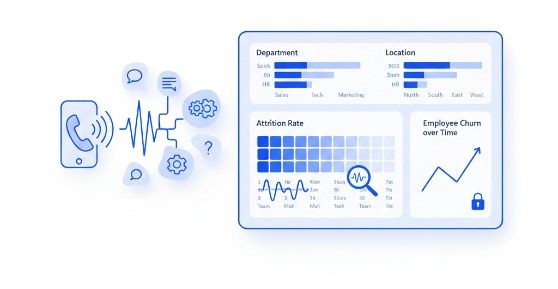
Automated exit interviews use technology — often an AI voice agent on a phone call — to ask every departing employee a consistent set of questions, capture their answers and organise them into themes. This gives HR teams comparable data to spot recurring reasons for resignations and attrition patterns across teams, roles, locations and tenure.
For HR managers, CHROs, People Ops and talent management leaders, the goal is not simply to collect more interviews. It is to understand what departing employees report, test those signals against other evidence and make better-informed retention decisions.
Key definitions
- Automated exit interview
- A departure interview in which technology coordinates or conducts repeatable questions and records responses.
- AI-powered exit interview
- An automated interview that uses conversational AI to ask questions, follow up and help organise answers.
- Employee attrition analysis
- Reviewing departures and associated feedback across groups and time to identify trends worth investigating.
- Voluntary attrition
- Employees leaving by choice, rather than through an employer-initiated separation.
What automated exit interviews are and how they work
Automated exit interviews add a repeatable feedback process to an existing exit journey. HR should choose the questions, participation rules and review owners before inviting employees.
Start from the exit process
A resignation or upcoming last day prompts an invitation. Participation should be explained clearly rather than assumed.
Offer a suitable time
Outreach and scheduling give the employee a chance to choose or reschedule a conversation during a busy notice period.
Ask a consistent core
Shared questions cover the role, reasons for leaving and experience at work, while allowing relevant local or role-specific additions.
Clarify and document
A voice agent can ask configured follow-ups. The conversation may then be transcribed and summarised for review.
Tag themes and review
Suggested themes make feedback easier to compare. HR checks the underlying answers, corrects mistakes and decides what needs escalation.
How AI-powered voice interviews automate employee feedback collection
A phone call can make participation possible without asking an employee to install an app or fill out another form. A conversational agent can ask open-ended questions and clarify an initial answer such as “better opportunity” or “personal reasons”, rather than treating that phrase as a complete explanation.
Configured voice interviews can accommodate interruptions and pauses, and offer another call time when someone is busy. Hindi, English and other supported Indian languages may help employees speak comfortably; teams should test the actual languages, accents and mixed-language answers used in their workforce.
A possible follow-up
Illustrative Hinglish exchange: a warehouse associate first says, “Personal reason hai.” Asked whether anything at work contributed, they mention delays in overtime payments and difficulties with a supervisor. HR should record those as reported concerns—not conclude that either caused the resignation without further review.
Common reasons employees give for leaving
Exit-interview and retention resources from SHRM and CIPD discuss themes like these. They are prompts for listening, not a universal ranking of why people leave.
Compensation and benefits
Listen for pay competitiveness, variable-pay clarity, delayed payments and benefits that do not meet an employee’s needs. Distinguish a specific pay concern from a general reference to a better offer.
Career growth and learning
Ask whether employees saw a credible path to advancement, useful training or internal opportunities. The absence of a pathway may mean different things to a new joiner and a long-tenured specialist.
Management and manager relationships
Listen for feedback about communication, support, expectations and trust. A reported concern deserves careful handling, but a theme tag alone is not a finding about any manager.
Work culture and team environment
Questions about belonging, collaboration and treatment can surface experiences not visible in a turnover spreadsheet. Preserve the employee’s wording and route sensitive disclosures appropriately.
Workload, shifts and work-life balance
Look for repeated mentions of overtime, unpredictable rosters or inadequate staffing. Ask when and where pressures occurred rather than assuming every team has the same conditions.
Job satisfaction and role fit
Explore whether day-to-day work matched what was described during hiring and whether employees had the tools to succeed. These answers may point toward onboarding or role-design questions.
Personal circumstances and relocation matter too. A migrant worker returning home or a family moving cities may describe a departure that a workplace change alone would not have prevented.
Identifying recurring themes and attrition trends
Employee attrition analysis becomes more useful when HR compares like with like and retains access to source responses. Small groups and incomplete participation can distort an apparent trend.
By department
Compare themes across functions while accounting for different working conditions and interview participation rates.
By role or level
A frontline employee and a senior specialist may describe different growth, workload or support needs.
By location
Repeated feedback from one city’s branches or one plant can guide local investigation without being generalised to the entire organisation.
By tenure
Compare early leavers—including those departing within 90 days—with long-tenured employees. Early feedback may raise questions about expectations or onboarding.
By manager
Review only appropriately sized groups, restrict access and avoid making individual judgements from a small set of exit comments.
Over time
Look for changes before and after a policy, staffing or operational change, while checking for seasonal effects and differences in who responded.
For example, tier-2-city BFSI branch sales staff might mention target pressure; IT services employees might discuss bench time or project allocation; retail store staff might mention festive-season shift rosters. These are examples of questions to investigate, not findings about those sectors.
Patterns vs proven causes
Exit feedback shows what leavers say. A recurring theme can correlate with departures without proving that it caused them. Validate it against engagement surveys, stay interviews, relevant HRMS data and manager conversations; then investigate alternative explanations before acting.
Potential benefits of automated exit interviews
Benefits depend on implementation, employee choice and the quality of human review. Compare a pilot with your existing process rather than assuming automation will improve every measure.
Less manual coordination
Repeatable invitations, questions and draft summaries can free HR from some scheduling and note-taking work.
More consistent questions
A shared core makes answers easier to compare while leaving room for unexpected issues and optional human conversations.
Earlier feedback review
Structured responses can surface a reported concern sooner, provided reviewers can check the original answer.
Multilingual conversations
Supported languages may widen access when tested with the accents and speech patterns employees actually use.
Collection across locations
A repeatable process can help distributed teams gather feedback, but scale should never replace consent or careful interpretation.
Traditional vs AI-powered automated exit interviews
Both approaches can be valuable. Keep a human-led route, especially for senior or critical exits, sensitive concerns and employees who prefer a person.
| Consideration | Traditional HR-led interview | AI-powered voice interview |
|---|---|---|
| Format | A conversation with an HR colleague or trained interviewer. | A disclosed AI agent asks configured questions by phone. |
| Scheduling | Depends on both people’s availability. | A configured workflow may coordinate outreach and call times. |
| Consistency | An interview guide helps; coverage may vary. | A common core can be asked consistently. |
| Follow-up depth | A person can explore unusual nuance in real time. | Can ask configured clarifications; complex issues need human review. |
| Languages | Depends on available interviewers. | Depends on languages the product supports and the team has tested. |
| Scale | Requires interviewer time for each conversation. | Repeatable calls may reduce coordination across locations. |
| Data structure | Notes depend on interviewer practice. | May provide transcripts, summaries and suggested themes. |
| Time to insight | Usually requires manual consolidation. | Draft themes may arrive sooner, subject to verification. |
| Perceived neutrality | Trust depends on the interviewer and confidentiality rules. | Perceptions vary; disclosure and clear access rules matter. |
| Strengths | Human judgement, empathy and sensitive escalation during the call. | Repeatability and structured collection, with HR oversight afterward. |
Explore a voice-led exit conversation
See how structured conversations can help your team review what departing employees say.
Turning exit insights into retention strategies
Feedback has value when it leads to a reviewable decision—not when a dashboard merely counts themes.
Prioritise
Consider how often a concern appears, its potential impact and how representative the interviews are.
Validate
Compare exit comments with engagement surveys, stay interviews, relevant HRMS data and manager conversations.
Assign owners and act
Possible responses include a pay-benchmarking review, clearer career pathways or internal mobility, manager coaching, better shift rosters and onboarding fixes for early leavers.
Communicate and re-measure
Explain appropriate changes without exposing individual feedback. Review later responses and retention measures to see whether the issue persists.
Key metrics to monitor
Define each measure consistently and inspect it alongside participation and workforce context. None is a standalone measure of whether an intervention worked.
| Metric | What it tells you | Watch-out |
|---|---|---|
| Exit interview participation rate | How many invited leavers take part. | Non-participants may have different experiences. |
| Feedback completion rate | How many participants finish the conversation. | A shorter interview is not necessarily a better one. |
| Specific vs generic reasons | Whether answers contain useful detail. | Do not pressure employees to disclose more. |
| Recurring attrition reasons | Which reported themes appear repeatedly. | Theme frequency does not establish causation. |
| Voluntary attrition trend | How employee-initiated departures change over time. | Check workforce size and external conditions. |
| Early attrition | Departures within the first 90 days or first year. | Keep time windows and definitions consistent. |
| Regrettable attrition | Losses the organisation has defined as particularly consequential. | Agree on a fair definition before reporting. |
| Time from exit to insight | How promptly feedback reaches a reviewer. | Speed cannot replace review accuracy. |
| Actions taken from insights | Whether reviewed feedback informs a response. | Track follow-through, not just actions logged. |
Privacy, confidentiality, data security and human oversight
Departing employees may disclose personal or sensitive information. Agree on safeguards and a human escalation path before collecting it.
Notice, purpose and retention
Explain what is collected, why, whether calls are recorded and how long records are kept. Assess applicable notice, consent and retention duties under India’s Digital Personal Data Protection Act, 2023 with qualified legal counsel.
Confidentiality
Disclose the AI interviewer and who can access raw transcripts. Limit access, report in aggregate where appropriate and use minimum group sizes so individuals are not identifiable. Do not promise anonymity the process cannot provide.
Data security
Ask a vendor about encryption, access controls, deletion, retention settings and incident handling. Confirm that the answers meet your own policies before rollout.
Human oversight
HR should inspect AI-generated tags and source answers, interpret themes and escalate harassment, safety or POSH-related concerns under policy. The NIST AI Risk Management Framework can inform evaluation. Employees should have an option to speak to a person.
Where Mishuk Labs fits
Mishuk Labs is an AI-powered conversational voice platform. Where configured for exit interviews, its AI voice agents can call departing employees, hold multilingual conversations, ask follow-up questions, handle interruptions and pauses, and turn conversations into transcripts and structured attrition themes for HR review.
HR teams design the questions, check the feedback and decide what action to take. An automated call complements—not replaces—a human conversation when someone requests one or a sensitive issue needs direct attention.
Explore AI exit interviewsWhy exit interviews fail in IndiaConclusion
Automated exit interviews can make departing employees’ feedback easier to collect and compare. They cannot, on their own, explain every resignation or guarantee better retention. Listen to what leavers say, protect their information, validate emerging patterns and let people—not theme tags—make the decisions.